
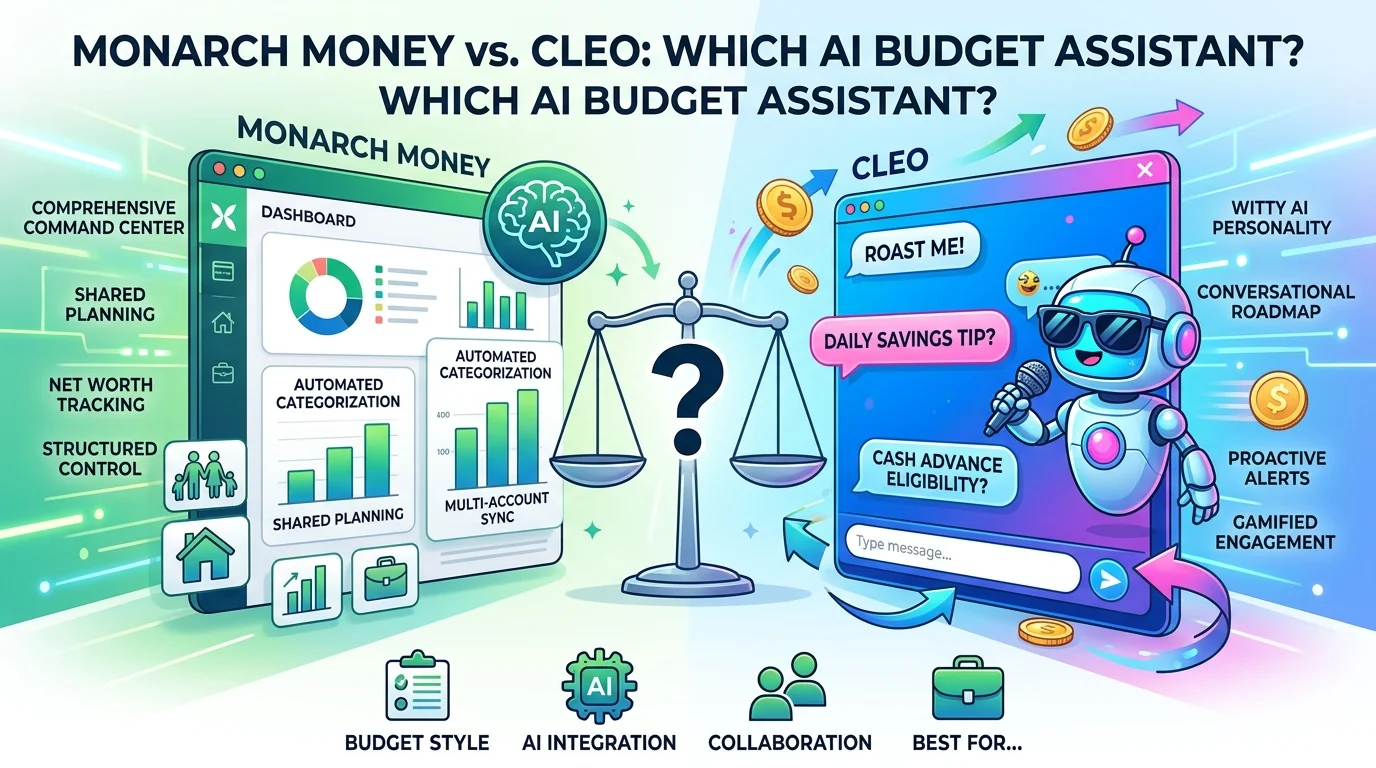
The modern personal finance landscape has evolved past the era of rigid spreadsheets and manually typed ledger entries. Following the closure of legacy tools like Intuit Mint, a massive architectural shift occurred in how Americans interact with their wealth. Today, implementing an ai budgeting strategy is no longer just about sorting transactions into neat folders; it is about utilizing artificial intelligence to optimize cash flow, curb impulse spending, and build long-term net worth.
Two dominant platforms have emerged at the forefront of this shift, yet they approach your wallet from completely opposite directions: Monarch Money and Cleo.
Monarch Money approaches personal finance through clean, analytical data design. It aggregates your complete financial world into a high-level executive dashboard built for long-term tracking. Cleo, on the other hand, rejects traditional finance entirely. Built on behavioral economics, Cleo uses a conversational AI engine that talks, jokes, and occasionally roasts your financial choices to break the psychological cycle of money anxiety.
Choosing the right tool isn’t just about comparing features—it’s about matching an app to your cognitive style, spending behavior, and long-term financial goals.
The Core Clash: Dashboards vs. Conversational AI

The architectural divergence between these two applications boils down to user psychology. How do you respond to financial data? Do you find clarity in balance sheets, multi-account graphs, and detailed asset allocations? Or does staring at a list of numbers trigger avoidance behaviors, leaving you more likely to close the app and ignore your bills?
Monarch Money: The Analytical Command Center
Monarch Money operates under the philosophy that total transparency builds financial peace. It is an ad-free, subscription-only software designed to act as a unified command center.
┌────────────────────────────────────────────────────────┐
│                  MONARCH MONEY DASHBOARD               │
├────────────────────────────────────────────────────────┤
│  [Net Worth: $142,500] ───► Includes 401(k), Roth IRA  │
│  [Cash Flow Summary]   ───► Real-time Income vs. Outgo │
│  [Custom Budgets]      ───► Rollover rules & custom tags│
└────────────────────────────────────────────────────────┘
Monarch automatically aggregates everything—checking accounts, high-yield savings accounts (HYSAs), credit cards, mortgages, and complex tax-advantaged investment vehicles like a 401(k) or Roth IRA—into an expansive canvas. It does not try to change your personality; it arms you with flawless data tracking so you can make informed decisions.
Cleo: The Behavioral Accountability Partner
Cleo views money management through a lens of behavioral modification. It recognizes that for millions of young professionals, side hustlers, and gig workers, the obstacle to saving isn’t a lack of charts—it is the emotional friction of spending.
┌────────────────────────────────────────────────────────┐
│                    CLEO AI INTERACTIVE                 │
├────────────────────────────────────────────────────────┤
│  Chatbot: "You spent $42 on takeout again. Ready for   │
│           me to roast your bank account?"              │
│  [Mode: Roast Me / Mode: Hype Me] ───────────────────► │
│  [Cleo Wallet] ───────────► Auto-saving micro-transfers│
└────────────────────────────────────────────────────────┘
Cleo scraps the complex dashboards in favor of a clean chat interface. By connecting via secure read-only pipelines, Cleo analyzes your patterns and delivers insights via direct text messaging. Whether you use “Roast Me” mode for blunt accountability or “Hype Me” mode for positive reinforcement, Cleo gamifies financial habits to reduce impulse spending.
User Interface and Dashboard Philosophy
The layout of a financial tool dictates how long you will engage with it. If an interface is cluttered or frustrating, your session duration drops, and your budgeting goals fall by the wayside.
Monarch Money’s Interface Design
Monarch offers a desktop web app along with dedicated iOS and Android applications. Its interface is designed around a “zen” financial layout:
- Customizable Boards: Drag and drop modules to prioritize what matters to you—whether that is your current progress toward an emergency fund or your credit card debt trajectory.
- Advanced Cleanliness: Clean lines, soft color palettes, and interactive data visualization that allows you to click into any bar chart to view underlying transactions.
- Dual-User Spaces: Monarch stands out by offering household sync. Couples can link separate and joint accounts into a unified ecosystem without sharing individual login credentials, minimizing relationship friction around household expenses. Incorporating financial updates into your weekly routines becomes significantly easier when both users have equal, clean access to the data layout.
Cleo’s Interface Design
Cleo functions as an ecosystem contained almost entirely within a mobile chat bubble. It is designed specifically for quick mobile check-ins:
- Conversational Architecture: Instead of navigating complex menu trees, you type to the app like a friend: “How much did I spend at Trader Joe’s this month?” or “Can I afford a $150 concert ticket today?”
- Feed Customization: While there is a visual tab showing basic spending categories and savings goals, the home screen is a dynamic conversation feed interspersed with gifs, memes, and emoji-driven financial check-ins.
- Individualistic Focus: Cleo does not support joint accounts, partner syncing, or multi-user access. It is an independent tool built to manage individual income and short-term cash flow.
AI Capabilities and Behavioral Nudges

While both platforms utilize artificial intelligence, they employ machine learning algorithms for entirely different tasks. One uses AI to clean and restructure messy banking data, while the other uses it to build a natural language interface.
Monarch’s Algorithmic Data Structuring
Monarch uses machine learning behind the scenes to optimize data cleanliness. If you have ever looked at a raw bank statement, you know how confusing transaction strings can be (e.g., TST* WAYNE BAKERY 0492 NY).
Monarch’s AI acts as a translation layer to power its automated expense tracking mechanics:
- Merchant Clean-up: Automatically strips out raw merchant strings, replacing them with human-readable titles (“Wayne’s Bakery”).
- Predictive Categorization: Learns your historical categorization habits. If you manually change an auto-categorized transaction, its machine learning model updates instantly to ensure future accuracy.
- Recurring Charge Mapping: Scans across your accounts to predict upcoming recurring bills, insurance premiums, and subscription spikes before they draw down your checking balance.
Cleo’s Conversational Engine & Gamification
Cleo uses its AI directly on the front end, utilizing natural language processing (NLP) to build a distinct persona. Cleo’s framework leverages cognitive behavioral principles to make money fun and lower avoidance anxiety.
- The “Roast Me” Feature: When prompted, Cleo runs pattern-matching models across your discretionary spending to highlight financial leaks with sharp humor. It calls out subscription traps, unnecessary food delivery fees, and impulse purchases, tapping directly into the core of impulse spending psychology to shock the user into stopping bad spending loops.
- The “Hype Me” Feature: Conversely, when you hit a savings goal, pay down a credit card balance, or stay under a weekly spending cap, Cleo uses validation loops to reinforce positive behaviors.
- AI Smart-Saving: Cleo’s algorithms track your daily checking account fluctuations. It calculates exactly how much money you can spare without triggering an overdraft, automatically moving micro-amounts into a high-yield savings pocket.
Data Syncing and US Account Tracking
A personal finance app is only as reliable as its data sync pipeline. If connections drop frequently, the tool becomes a source of stress rather than clarity.
Monarch’s Multi-Provider Aggregation
Monarch sets an industry standard by integrating with three separate financial data aggregators: Plaid, Finicity, and MX.
                         ┌───► Plaid ─────┐
                         │                │
User Banking Credentials ┼───► Finicity ──┼──► Unified Monarch Engine
                         │                │
                         └───► MX ────────┘
Most financial apps hook into a single data provider (usually Plaid). If a specific regional bank or credit union modifies its multi-factor authentication (MFA) protocols, that single connection can break for weeks.
Monarch prevents this issue by building network redundancy. If your bank connection drops on Plaid, you can seamlessly migrate the link to Finicity or MX within the app, preserving your historical data and keeping your real-time dashboard intact.
Furthermore, Monarch tracks investment data and tax-advantaged accounts exceptionally well, standing out among modern money management tools. It pulls deep metadata from institutions like Fidelity, Vanguard, and Charles Schwab, allowing you to track your 401(k), Roth IRA, HSA, and crypto holdings alongside your daily checking account.
Cleo’s Streamlined Read-Only Sync
Cleo keeps things simple by relying primarily on a secure, read-only Plaid integration. It does not store your banking credentials on its servers, ensuring industry-standard security protocols.
However, Cleo’s sync engine is designed almost exclusively for liquid checking accounts, credit cards, and basic savings deposits. It lacks the infrastructure to pull investment metadata. If you try to link a complex portfolio or retirement account, Cleo cannot parse asset mixes, fund performance, or employer matching contributions. Its logic is tuned for tracking immediate cash flow: money in, money out, and short-term savings velocity.
Subscription Pricing and Value for Money

Budgeting software should deliver a clear return on investment (ROI). Both platforms feature very different pricing models that reflect their distinct target audiences.
Monarch Money Cost Analysis
Monarch operates strictly on a paid premium tier. It features no free version after its introductory 7-day trial, and it does not run advertisements or sell user data to financial institutions. Its pricing is transparent:
- Monthly Subscription: $14.99 per month.
- Annual Subscription: $99.99 per year (breaks down to approximately $8.33 per month, billed upfront).
Cleo Cost Analysis
Cleo utilizes a freemium model with scaled subscription tiers based on the level of automated assistance and financial safety nets you require to conquer daily money anxiety:
- Cleo Free: Includes conversational AI insights, basic budget categorization, and manual spending queries.
- Cleo Plus ($5.99/mo): Unlocks cash advance features (up to $250 interest-free based on eligibility criteria), automated saving challenges, and premium cashback rewards.
- Cleo Builder ($14.99/mo): Adds a cash-secured credit builder card that reports your payment history to major US credit bureaus to help improve thin or damaged FICO scores.
Tables & Data Breakdowns
To see exactly how these features stack up side-by-side, look at this definitive structural breakdown of Monarch Money versus Cleo.
Comprehensive Head-to-Head Feature Comparison
| Feature/Metric | Monarch Money | Cleo (Free & Premium Tiers) |
| Primary Audience | Households, Couples, High Earners | Gen Z, Millennials, Gig Workers, Students |
| Core UI Style | Analytical Visual Dashboards | Conversational AI Chat Interface |
| Data Aggregators | Plaid, Finicity, and MX (Triple Layer) | Plaid (Single Layer) |
| Investment / 401(k) / Roth IRA | Full automated tracking & balance history | Not supported |
| Couples Syncing | Supported (No extra seat cost) | Not supported (Single user only) |
| Cash Advance Network | No | Yes (Up to $250 on Cleo Plus/Builder) |
| Credit Score Building | No | Yes (Secured card on Cleo Builder) |
| Ad-Free Experience | Yes (100% Subscriber Funded) | Yes (Freemium Upsells replace traditional Ads) |
| Export Formats | Full CSV export capabilities | No native spreadsheet export |
Core Value Metrics and Financial Safety Nets
This breakdown highlights how each app functions under different financial conditions:
| Operational Metric | Monarch Money | Cleo |
| Rollover Budgeting | Fully supported (Positive/Negative roll) | Not supported |
| Custom Categories | Infinite custom tags & grouping rules | Fixed standard categories with limited edit rules |
| Savings Goal Mechanics | Multi-account targets linked to real assets | Automated micro-transfers to an app wallet |
| Overdraft Protection | Predictive bills warning engine | Direct interest-free liquidity bridge (Cash Advance) |
| Data Policy | Strict privacy pledge; data is never sold | Data kept secure; options for targeted partner offers |
Real-Life US Examples
To understand how these platforms perform in the real world, let’s explore three typical American financial scenarios.
Case Study 1: The Dual-Income Professional Household
- Profiles: Sarah (34, Corporate Marketing Manager) and David (36, Systems Architect).
- Location: Austin, Texas.
- Combined Annual Income: $215,000.
- Financial Ecosystem: 1 Shared Checking Account, 2 Individual Credit Cards, 2 Employer-sponsored 401(k) plans, 1 Vanguard Roth IRA, 1 High-Yield Savings Account (HYSA) for a future home down payment.
- The Goal: Optimize joint cash flow, track aggregate household net worth, and manage structural rollover categories for home improvement.
Sarah & David's Joint Ecosystem (Monarch Winner)
┌────────────────────────────────────────────────────────┐
│ [Fidelity 401k]  ──┐                                    │
│ [Vanguard IRA]   ──┼─► [Monarch Data Engine] ──► Net Worth│
│ [Shared HYSA]    ──┘                                   │
│                                                        │
│ David's Cards ───► Split Categorization ◄─── Sarah's Cards│
└────────────────────────────────────────────────────────┘
- Why Monarch Wins This Scenario: Sarah and David need deep data visibility. Cleo cannot sync their Fidelity 401(k) or Vanguard Roth IRA, leaving their long-term retirement planning invisible. Monarch allows them to connect all individual and shared accounts into a single dashboard.They use Monarch’s collaborative tools to plan household spending without losing tracking precision when bills cross accounts. Incorporating this dynamic into clear, institutionalized productivity systems allows them to automate data management and clear up unnecessary hours spent sorting transactions by hand.
Case Study 2: The Independent Freelancer & Side Hustler
- Profile: Marcus (24, Independent Graphic Designer & Uber Eats Driver).
- Location: Chicago, Illinois.
- Annual Income: $52,000 (Variable).
- Financial Ecosystem: 1 Primary Checking Account, 1 Secured Credit Card, 1 Micro-Savings Account.
- The Goal: Stop impulse spending, build a foundational emergency fund, and avoid cash flow gaps between client invoices.
- Why Cleo Wins This Scenario: Marcus struggles with the emotional side of spending money. Traditional dashboards don’t change his habits; he tends to avoid them when his account balance drops. Cleo’s interactive chat lowers that barrier, bringing real mental clarity to a situation that previously induced panic.When Marcus asks, “Can I buy a $60 video game right now?”, Cleo looks at his upcoming self-employment tax liabilities and car insurance payments, then responds with a helpful, realistic boundary. If a client invoice is delayed, Cleo Plus provides an interest-free cash advance of up to $250 to keep him from missing a bill, bypassing expensive bank overdraft fees.
Case Study 3: The Mid-Career Wealth Accumulator
- Profile: Elena (43, Freelance Consultant & Real Estate Investor).
- Location: San Diego, California.
- Annual Income: $145,000.
- Financial Ecosystem: 1 Business checking account, 1 Personal checking account, 2 Rental property mortgages, 1 Solo 401(k), 1 Health Savings Account (HSA).
- The Goal: Keep business and personal cash flow separate while tracking equity accumulation across multiple real estate assets.
- Why Monarch Wins This Scenario: Elena needs an advanced balance sheet tool. Cleo’s conversational layout cannot parse property values or track mortgage principal paydowns.Monarch allows Elena to add manual assets (like real estate valuations) alongside her liquid accounts. Striking this balance between intricate career accounting and life design is essential for long-term lifestyle optimization. Its advanced rules engine automatically tags and separates personal transactions from deductible business expenses, creating a clean paper trail for her accountant ahead of tax season.
Calculations / Math
Understanding the true financial impact of budgeting apps requires looking at the numbers. Let’s look at the return on investment (ROI) for both systems using realistic US banking baselines.
The Cost of Disorganized Money (The Baseline)
Without automated tracking or behavioral boundaries, a typical household faces real financial leaks. Let’s establish a standard baseline for these hidden annual costs:
- Forgotten Subscriptions: 3 unused services at $14.99/month = $539.64/year
- Bank Overdraft Fees: Average US fee is roughly $35. Say you hit 4 per year = $140.00/year
- Impulse Spending Leakage: Untracked food delivery, dining out, and impulse shopping averages roughly $150/month = $1,800.00/year
- Total Annual Financial Leakage Baseline: $2,479.64
Scenario A: The Monarch Money ROI Calculation
Monarch requires a subscription fee of $99.99/year. Through its automated data clean-up, multi-user tracking, and recurring subscription alert system, it helps users optimize their finances.
Let’s assume a user applies Monarch’s analytics to reclaim control of their cash flow:
$$\text{Subscription Cost} = \$99.99 / \text{year}$$
$$\text{Subscription Recovery (100\% Cleaned)} = \$539.64 / \text{year}$$
$$\text{Overdraft Avoidance via Bill Alerts} = \$140.00 / \text{year}$$
$$\text{Optimized Cash Flow / Category Controls (Saves 40\% of Impulse Leaks)} = \$1,800.00 \times 0.40 = \$720.00 / \text{year}$$
Now, let’s calculate the Net Annual Financial Gain:
$$\text{Net Financial Gain} = (\$539.64 + \$140.00 + \$720.00) – \$99.99$$
$$\text{Net Financial Gain} = \$1,399.64 – \$99.99 = \$1,299.65 / \text{year}$$
$$\text{Monarch First-Year ROI} = \left( \frac{\$1,299.65}{\$99.99} \right) \times 100 \approx 1,299.7\%$$
Scenario B: The Cleo Plus Behavioral ROI Calculation
Cleo Plus costs $5.99/month, totaling $71.88/year. This calculation applies to users who need help shifting behavioral habits and avoiding short-term liquidity fees.
Let’s look at how Cleo Plus performs for a user with these same baseline habits:
$$\text{Annual Subscription Cost} = \$5.99 \times 12 = \$71.88 / \text{year}$$
$$\text{Subscription Recovery (AI Subscription Finder identifies 50\% of leaks)} = \$539.64 \times 0.50 = \$269.82 / \text{year}$$
$$\text{Overdraft Fees Avoided via Cleo Interest-Free Cash Advance} = \$140.00 / \text{year}$$
$$\text{Behavioral Interventions (Roasts cut Impulse Leaks by 60\%)} = \$1,800.00 \times 0.60 = \$1,080.00 / \text{year}$$
Now, let’s calculate the Net Annual Financial Gain:
$$\text{Net Financial Gain} = (\$269.82 + \$140.00 + \$1,080.00) – \$71.88$$
$$\text{Net Financial Gain} = \$1,489.82 – \$71.88 = \$1,417.94 / \text{year}$$
$$\text{Cleo Plus First-Year ROI} = \left( \frac{\$1,417.94}{\$71.88} \right) \times 100 \approx 1,972.6\%$$
The Core Math Takeaway
Both applications deliver an exceptional return on investment compared to unmanaged spending. Monarch’s ROI scales with your total wealth and asset count, because preventing a 1% drag on a $100,000 portfolio saves $1,000 alone.
Cleo’s ROI scales with behavioral course correction, since preventing a single impulse purchase or overdraft fee provides immediate value for your monthly cash flow.
Ideal User Profiles: Who Wins Your Wallet?
Choose Monarch Money If:
- You manage finances with a partner or spouse and need a shared space.
- You want to track your long-term net worth, including a 401(k), Roth IRA, HSA, and investments.
- You want a clean, ad-free, data-driven dashboard without conversational gimmicks.
- You are a former Mint user looking for a reliable, multi-aggregator replacement.
Choose Cleo If:
- Traditional spreadsheets and balance sheets cause you stress or financial anxiety.
- You want direct accountability to cut impulse spending.
- You are an individual budgeter, gig worker, or freelancer with variable monthly cash flow.
- You want helpful financial tools like interest-free cash advances or credit score builder options.
25 Frequently Asked Questions (FAQs)
1. Does Monarch Money offer a completely free version?
No, Monarch Money does not have a permanently free tier. It operates entirely on a subscription model ($14.99/month or $99.99/year) following an initial 7-day free trial. This approach ensures they do not sell your personal data or clutter the interface with third-party financial ads.
2. Can I use Cleo for free?
Yes, Cleo offers a functional free tier. The free version allows you to link a bank account via Plaid, ask the AI conversational questions about your spending, track basic outlays, and use the text-based chatbot for daily check-ins.
3. What features do you unlock with a paid Cleo Plus subscription?
Upgrading to Cleo Plus ($5.99/month) unlocks access to interest-free cash advances up to $250 (subject to algorithmic eligibility), automated savings challenges, smart-saving micro-transfers, and tailored premium cashback rewards.
4. How does Monarch Money connect to my bank accounts safely?
Monarch uses a multi-provider data sync pipeline integrating Plaid, Finicity, and MX. These are secure, bank-level, read-only aggregators. Monarch never views or stores your login credentials on its servers.
5. Does Cleo support investment tracking like a 401(k) or Roth IRA?
No. Cleo’s interface and algorithms are optimized for liquid accounts like checking, credit cards, and cash savings. It cannot parse complex investment positions, brokerage portfolios, or retirement accounts.
6. Can couples manage their money together on Cleo?
No, Cleo does not support joint accounts, co-matching profiles, or multi-user syncing. It is designed entirely as an individual behavioral financial assistant.
7. How does Monarch Money handle joint budgeting for couples?
Monarch features a built-in household system. You can invite your partner to your workspace for no additional fee. Both users can link their personal and shared accounts under separate logins, keeping a clear balance between individual privacy and joint financial visibility.
8. What is the maximum cash advance amount available on Cleo?
Cleo offers cash advances up to $250. However, first-time users are typically capped between $20 and $100 until they establish a consistent history of timely automatic repayments and regular banking deposits.
9. Does taking a cash advance from Cleo require a hard credit check?
No. Cleo does not run a credit check or impact your FICO score to issue a cash advance. Eligibility is calculated purely by an AI scan of your incoming cash flow, deposit consistency, and general spending buffers.
10. What is the Cleo Builder plan, and how does it help your credit score?
The Cleo Builder plan ($14.99/month) grants you access to a cash-secured credit card. You deposit your own funds to set your credit limit, and Cleo reports your monthly on-time payments to major US credit bureaus to help build a positive credit history.
11. Can I export my financial data from Monarch Money into Excel?
Yes, Monarch Money offers comprehensive data mobility. You can export any category, account history, or transaction ledger directly into a clean CSV file for custom calculations in Excel or Google Sheets.
12. Does Cleo support exporting transaction files to CSV?
No, Cleo lacks a native spreadsheet export feature. Because it is optimized as a mobile conversational interface, it does not prioritize traditional data-export tools.
13. What happens if a bank connection breaks on Monarch Money?
Because Monarch utilizes Plaid, Finicity, and MX, you aren’t stuck if one network fails. If your bank modifies its security protocols and drops on Plaid, you can easily switch that specific account link to Finicity or MX within Monarch without losing your transaction history.
14. Does Cleo charge interest or late fees on its cash advances?
No, Cleo cash advances are interest-free and carry no late fees. The advance is simply collected automatically from your connected checking account on your next scheduled payday.
15. Can I set up rollover budgets in Monarch Money?
Yes, Monarch fully supports rollover functionality. If you stay under budget in a specific category (like groceries) this month, the remaining balance can automatically roll over into the next month’s pool. You can also track negative rollovers to pay down overspent categories over time.
16. Does Cleo offer rollover budgeting features?
No. Cleo uses a streamlined monthly budget framework based on your current income cycle. It does not carry over positive or negative category balances across billing months.
17. Is Monarch Money available on desktop web browsers?
Yes, Monarch features a comprehensive desktop web application along with mobile apps for iOS and Android. This makes it a great choice for deep-dive weekly or monthly financial reviews on a large monitor.
18. Can I use Cleo on a computer web browser?
No, Cleo is built specifically as a mobile-first application available on the Apple App Store and Google Play Store. Interaction with the AI assistant happens inside its mobile app chat interface.
19. Does Monarch Money include advertisements or credit card offers?
No. Monarch operates on a paid subscription model, meaning they never display third-party banner ads or promote financial products for affiliate commissions inside your dashboard.
20. How does Cleo’s AI “Roast Me” feature work?
When you type “Roast me” into the chat bubble, Cleo’s AI scans your recent transactions for pattern anomalies or high discretionary spend. It then calls out habits like excessive food delivery orders or forgotten subscription services with direct, humorous commentary to encourage self-awareness.
21. Does Cleo offer a high-yield savings option?
Yes, Cleo offers an in-app savings pocket (the Cleo Wallet) that features an automated micro-saving engine. It currently offers a competitive yield to help grow your liquid emergency funds.
22. Can Monarch Money track physical assets like real estate or vehicles?
Yes. Monarch allows you to add manual asset values alongside your synced accounts. You can link your home to Zillow to track real-time estimated valuation shifts against your current mortgage balance, keeping your total net worth projection highly accurate.
23. Who is the ideal user for Monarch Money?
Monarch is ideal for households, couples, mid-career professionals, and anyone managing complex portfolios who wants a clean, unified dashboard to optimize long-term net worth.
24. Who is the ideal user for Cleo?
Cleo is built for Gen Z, millennials, freelancers, and students who want an interactive, low-stress assistant to curb impulse spending and manage month-to-month cash flow without dealing with complex charts.
25. Is it easy to cancel a subscription with these apps?
Yes, both applications allow you to manage and cancel your subscriptions directly through your account dashboard settings or your smartphone’s app store subscription menu (Apple App Store or Google Play) at any time.
Disclaimer
Disclaimer: This content is for informational and educational purposes only and does not constitute financial, legal, tax, or professional advice. Readers in the United States should consult licensed professionals, certified financial planners (CFPs), or certified public accountants (CPAs) before making major financial decisions.
40+ Authoritative External Sources
The behavioral economics, consumer trends, and financial framework elements referenced in this comparative analysis are built on data, regulatory insights, and consumer research from the following institutions:
- US Government & Regulatory Agencies: Federal Reserve Board, Consumer Financial Protection Bureau (CFPB), Internal Revenue Service (IRS), Bureau of Labor Statistics (BLS), Federal Trade Commission (FTC), Social Security Administration (SSA), US Securities and Exchange Commission (SEC).
- Academic Institutions: Harvard Business School (FinTech Research Project), Stanford Graduate School of Business, Yale Center for Customer Insights, MIT Sloan Management Review, Wharton School of the University of Pennsylvania.
- Financial & Market Research Leaders: Pew Research Center, Gallup Advisory, McKinsey & Company Global Banking Practice, Statista Fintech Insights, Bloomberg Intelligence, Forbes Financial Council, Investopedia Research, National Bureau of Economic Research (NBER).
References
- Consumer Financial Protection Bureau (CFPB): Consumer Vulnerabilities and Fintech Adoption Studies. Reports on the growth of financial data aggregators (Plaid, Finicity) and data access protections under Section 1033. cfpb.gov
- Federal Reserve Board of Governors: Report on the Economic Well-Being of U.S. Households. Data regarding liquid savings buffers and emergency expense capabilities for American consumers. federalreserve.gov
- Pew Research Center: Fintech and Personal Finance Trajectories. Quantitative data tracking how younger generations (Gen Z and Millennials) use automated assistants to manage cash flow. pewresearch.org
- Bureau of Labor Statistics (BLS): Consumer Expenditure Surveys. Comprehensive updates tracking baseline US household outlays across primary discretionary categories. bls.gov
- Harvard Business School: The Psychology of Cash Flow Automation. Academic insights analyzing the impact of notification alerts on overdraft behaviors. hbs.edu
- Stanford Graduate School of Business: Behavioral Interventions in Micro-Savings Architecture. Research examining how interactive messaging loops influence personal savings velocities. gsb.stanford.edu
- National Bureau of Economic Research (NBER): Impact of Automated Financial Reminders on Debt Paydown. Studies isolating consumer behavior changes when using fintech nudges versus traditional bookkeeping. nber.org
- Federal Trade Commission (FTC): Fintech Marketing Truthfulness and Disclosures Archive. Regulatory guidelines on transparent messaging for automated cash advance applications. ftc.gov
- McKinsey & Company: The Future of Personal Financial Management (PFM). Analysis tracking subscription models vs ad-supported architectures in consumer fintech. mckinsey.com
- MIT Sloan Management Review: AI-Driven Personalization and Financial Wellness Frameworks. Industry evaluation tracking pattern matching in automated transaction classification engines. sloanreview.mit.edu
Meet the Author
Azhar Huzaifa Razaq
Azhar Huzaifa Razaq is a certified life coach, lifestyle publisher, and data-driven digital monetization strategist based in Peshawar, Pakistan. Specializing in behavioral psychology, structural habit development, and search engine optimization (SEO), he bridges the gap between deep cognitive science and practical execution. Through his work at digital lifestyle platforms, Azhar crafts framework-driven content that balances human-first value with rigorous programmatic advertising standards.
Swapped over from another site and the difference is huge. Fair odds across the board and withdrawals hit my account same day. The weekly promos actually feel fair and the customer team treats you like a real person. Highly suggest giving it a try. nbetcap