
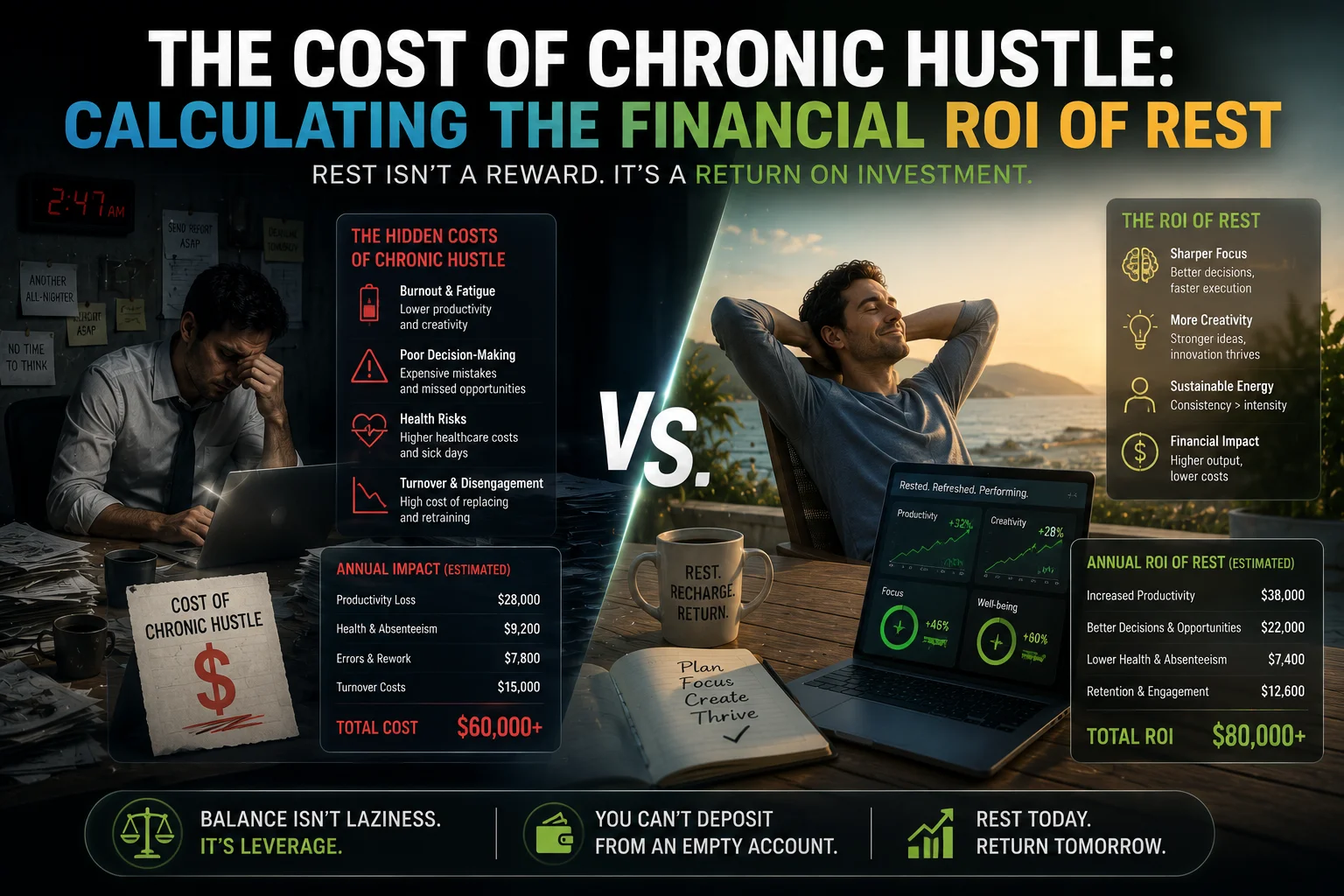
In the United States, “hustle culture” has long been wearing a badge of honor. From Silicon Valley tech hubs to Wall Street trading floors and Main Street small businesses, the prevailing narrative dictates that success requires sacrificing sleep, skipping vacations, and maintaining a state of perpetual exhaustion. We treat sleep deprivation as a metric of dedication and chronic stress as the price of admission for upward mobility.
However, a cold, hard look at macroeconomic data and household balance sheets reveals a glaring flaw in this philosophy. The relentless pursuit of productivity without recovery is not a wealth-building strategy; it is a financial drain.
When you factor in skyrocketing American healthcare premiums, missed career advancements due to cognitive decline, and the insidious accumulation of lifestyle “convenience taxes,” the financial cost of burnout becomes staggering. True professional optimization requires treats downtime not as a luxury, but as an investment.
By calculating the literal ROI of rest and implementing structured stress management for career growth, you can stop leaking capital and start building sustainable wealth.
The Anatomy of Hustle Culture: An Economic Mirage

The American workplace is facing a quiet crisis. According to extensive tracking by the American Psychological Association (APA), stress levels across the nation remain at historic highs, with work consistently cited as a primary driver. For decades, workers have operating under the assumption that more hours automatically equal more output and higher compensation. This linear equation, however, ignores human biology.
When corporate professionals, entrepreneurs, and gig workers push past their optimal cognitive capacity, they enter a zone of diminishing returns. The extra three hours tacked onto a 12-hour workday do not yield high-value breakthroughs; instead, they generate errors, necessitate re-work, and compromise strategic decision-making.
The U.S. economy pays a steep price for this collective exhaustion. The Centers for Disease Control and Prevention (CDC) and various occupational health reports note that productivity losses tied to worker fatigue cost American businesses billions annually. For an individual, this systemic drain manifests directly on your W-2, your brokerage accounts, and your medical insurance claims.
The Microeconomic Drain: The Hard Financial Cost of Burnout
The most immediate, quantifiable penalty of chronic hustle is found within the American healthcare system. Chronic stress triggers a physiological cascade, elevating cortisol and adrenaline levels, which over time compromises the immune system and drives cardiovascular wear and tear.
1. Chronic Medical Expenditures
When burnout escalates into clinical physical illness, the financial toll lands squarely on the individual via deductibles, copays, and co-insurance. An American worker navigating high-functioning anxiety or severe burnout often faces an array of medical costs:
- Primary Care and Specialist Visits: Frequent appointments to address stress-induced gastrointestinal issues, chronic migraines, or unexplained fatigue.
- Mental Health Services: Out-of-pocket psychotherapy or psychiatric sessions, particularly if provider networks are limited.
- Prescriptive Interventions: Ongoing costs for selective serotonin reuptake inhibitors (SSRIs), sleep aids, and blood pressure medications.
2. The High Cost of American Health Insurance
Even with employer-sponsored health insurance, out-of-pocket maximums in the U.S. can reach up to $9,450 for individuals and $18,900 for families on marketplace plans. A single stress-induced emergency room visit for panic attack symptoms mimicking a myocardial infarction can instantly wipe out a worker’s emergency savings account.
By failing to prioritize structured recovery, professionals frequently end up trading their health for wealth in their 20s and 30s, only to spend that hard-earned wealth buying back their health in their 40s and 50s.
The Convenience Tax: How Exhaustion Inflates Your Monthly Budget

When you are chronically exhausted, your capacity to make economically rational decisions collapses. Executive dysfunction sets in, making the path of least resistance the only viable option. This creates what financial planners call the “convenience tax”—a series of premium premiums paid purely to outsource basic life tasks that an energized individual could manage efficiently.
Grocery and Meal Delivery Over-Reliance
Consider a standard corporate professional in an urban center like Chicago or New York. After a grueling 11-hour day, the mental energy required to meal plan, grocery shop, and cook is entirely depleted. The alternative? DoorDash, UberEats, or Grubhub.
A single delivery order that would cost $12 at the grocery store easily inflates to $35 once service fees, delivery charges, regulatory fees, and tips are appended. When repeated multiple times a week, this single habit leaks thousands of dollars of post-tax income annually.
Premium Services and Impulse Purchases
The convenience tax extends far beyond food. It includes:
- Last-Minute Ridesharing: Opting for an expensive Uber XL or Lyft Premium because you missed the subway or are too exhausted to navigate public transit.
- Expedited Services: Paying for rush shipping, premium laundry services, or automated home maintenance because your weekends are spent in a comatose state on the couch.
- The “Dopamine Spend”: Retail therapy driven by burnout. When work provides zero emotional fulfillment, retail platforms like Amazon become instant sources of short-term satisfaction, leading to unneeded impulse purchases.
The Career Trajectory Toll: Lost Promotions and Cognitive Decline
While the immediate medical expenses and convenience taxes are damaging, the long-term career opportunity costs of chronic hustle are catastrophic. The modern knowledge economy rewards creativity, emotional intelligence (EQ), high-level problem solving, and strategic foresight. Chronic sleep deprivation and burnout systematically dismantle these exact cognitive functions.
Cognitive Bottlenecks and Errors
Research out of Harvard Medical School highlights that sleep deprivation directly degrades the prefrontal cortex—the region of the brain responsible for logical reasoning, risk assessment, and emotional regulation. A burned-out manager is more likely to miss critical details in a client pitch, commit accounting errors, or lash out at a direct report.
[Chronic Hustle] ➔ [Sleep Deprivation] ➔ [Prefrontal Cortex Decline] ➔ [Poor Workplace Decisions] ➔ [Missed Promotions]
The Networking and Visibility Deficit
Upward mobility in the corporate hierarchy requires energy to network, build political capital, and champion high-impact initiatives. A professional operating in survival mode does not have the capacity to volunteer for visibility projects, mentor junior staff, or present at industry conferences. They do the bare minimum required to keep their head above water.
Over a five-to-ten-year horizon, this deficit can mean the difference between ascending to a C-suite role with equity options or remaining stuck in mid-level management, costing hundreds of thousands of dollars in lifetime earnings.
The Mathematical Blueprint: Calculating the ROI of Rest

To shift your perspective from viewing rest as a liability to viewing it as an asset, we must apply traditional corporate finance principles to human capital. We can determine the ROI of rest by comparing the financial upside of recovery against the total costs incurred by continuous overexertion.
Defining Human Asset Optimization
If a machine in a manufacturing plant is run at 100% capacity 24/7 without maintenance, it will eventually seize, halting production and requiring expensive capital replacement. The corporate executive or entrepreneur is no different.
By consciously budgeting downtime—such as utilizing your full Paid Time Off (PTO) allocation, protecting an eight-hour sleep window, and taking digital sabbaticals—you optimize your human capital asset value.
The Financial Returns of a Rested State
When an individual operates with an optimized cognitive reserve, the financial gains manifest in three distinct buckets:
- Expense Mitigation: Eliminating the convenience taxes and medical out-of-pocket expenses detailed above.
- Performance Premiums: Securing higher performance bonuses, commissions, and raises due to superior work execution and innovation.
- Career Longevity: Extending your peak earning years by avoiding mid-career health collapses or forced early retirements due to stress-related disabilities.
Stress Management for Career Growth: A Practical US Strategy Guide
Transitioning away from a toxic hustle mindset does not mean abandoning ambition. Rather, it requires adopting strategic stress management for career growth. This systematic approach treats recovery as a high-leverage professional tool.
1. Establish Non-Negotiable Boundaries Around Sleep
Sleep is the ultimate economic force multiplier. Treat your sleep window like an irreplaceable client meeting. Eliminate blue light exposure 45 minutes before bed, keep your bedroom temperature around 65 to 68 degrees Fahrenheit, and establish a consistent wake-up time. Optimizing sleep improves working memory, processing speed, and emotional stability.
2. Execute High-Value Strategic Offloading
Instead of spending money on reactive convenience taxes (like late-night delivery fees), proactively invest in structural outsourcing that saves you time and mental energy. Hire a dedicated virtual assistant, use a structured meal-prep service that aligns with your nutritional goals, or schedule a recurring home cleaning service. This converts low-value chores into pristine, guilt-free recovery time.
3. Maximize and Protect Your Professional Benefits
If you are an employee in corporate America, your compensation package includes benefits explicitly designed to mitigate stress. Use them fully:
- Take 100% of Your PTO: Studies show that taking vacation time correlates with higher promotion rates, as it prevents systemic burnout and fosters fresh strategic perspectives.
- Leverage Employee Assistance Programs (EAPs): Many US corporations provide free, confidential counseling sessions, legal advice, and stress management resources.
- Maximize HSA/FSA Accounts: Use pre-tax dollars from Health Savings Accounts or Flexible Spending Accounts to fund preventative care, massage therapy (if medically prescribed), and mental health services.
Comprehensive Cost and ROI Tables
To contextualize these concepts, let us look at the financial realities. The following data models contrast the financial profile of a chronically burned-out professional with that of an optimized, rested individual operating in a similar US corporate landscape.
Table 1: The Annual Convenience Tax & Medical Breakdown (The Burnout Profile)
| Expense Category | Monthly Burnout Cost (USD) | Annualized Capital Drain (USD) | Root Behavioral Cause |
| Reactive Food Delivery | $450.00 | $5,400.00 | Executive exhaustion; lack of meal prep capacity |
| Medical Copays & Deductibles | $250.00 | $3,000.00 | Stress-induced GI flare-ups, migraines, illness |
| Mental Health Out-of-Pocket | $300.00 | $3,600.00 | Reactive therapy for acute workplace anxiety |
| Impulse Retail Therapy | $200.00 | $2,400.00 | Dopamine seeking due to professional dissatisfaction |
| Rideshare & Premium Shipping | $150.00 | $1,800.00 | Poor time management caused by severe fatigue |
| Total Wasteful Expenditures | $1,350.00 | $16,200.00 | Systemic lifestyle failure from overwork |
Table 2: The ROI of Rest Investment & Return Spectrum
| Strategic Rest Input | Upfront Annual Cost (USD) | Tangible Annualized Financial Return (USD) | Net ROI (%) |
| Consistent 8-Hour Sleep Routine | $0.00 | $8,500.00 (Performance Bonus Increase) | $\infty\%$ |
| Full Utilization of Allocated PTO | $0.00 | $6,000.00 (Avoided Attrition/Sick Leave) | $\infty\%$ |
| Proactive Meal-Prep Service | $3,600.00 | $5,400.00 (Eliminated On-Demand Delivery) | $50.0\%$ |
| Preventative Wellness & Massage | $1,200.00 | $3,000.00 (Reduced Emergency Medical Costs) | $150.0\%$ |
| Totals | $4,800.00 | $22,900.00 | $377.1\%$ |
Real-Life Examples and Case Studies
Case Study 1: The Mid-Level Tech Manager (Silicon Valley, CA)
Sarah, a 34-year-old Senior Product Manager at a mid-sized technology firm in San Francisco, prided herself on working 70-hour weeks. She slept an average of 5 hours a night and answered Slack messages at 2:00 AM.
Over a 24-month period, her physical health deteriorated, leading to severe acid reflux and an emergency room visit for what she thought was a heart attack but was diagnosed as a severe panic attack. The out-of-pocket medical bill after her high-deductible health plan (HDHP) was $4,200.
Furthermore, due to persistent cognitive fatigue, she made a major scoping error on a product roadmap, delaying a launch by a quarter. When annual reviews arrived, she was passed over for a Director promotion that carried a $25,000 base salary raise and equity grants.
By refusing to rest, Sarah lost over $29,000 in direct wealth in a single calendar year.
Case Study 2: The Independent Strategy Consultant (Austin, TX)
David, a 41-year-old independent corporate consultant in Austin, Texas, was caught in a cycle of constant client acquisition and delivery, working through weekends and skipping vacations for three straight years. His revenue was strong, but his profit margins were bleeding out through an upscale convenience tax profile: premium last-minute flights, daily meal deliveries, and high reliance on outsourced administrative fixes to patch errors made by his tired brain.
After realizing his net wealth was stagnating despite top-line revenue growth, David instituted a “No Work Weekends” policy and committed to a strict sleep schedule.
Within six months, his mind cleared. He restructured his consulting packages, automated his lead generation, and confidently pitched a Fortune 500 client with a high-value strategy that he previously lacked the mental energy to design. His revenue increased by 35%, while his stress-related convenience spending dropped by $12,000 annually.
Mathematical Breakdowns: The Equations of Exhaustion vs. Rest
To firmly establish why rest is a high-yield wealth-building strategy, let’s look at the financial math.
1. The Cost of Chronic Burnout Formula
We can calculate the total economic loss ($L_b$) incurred by an individual suffering from chronic hustle through the following equation:
$$L_b = C_m + C_t + I_m$$
Where:
- $C_m$ = Out-of-pocket medical expenditures (copays, deductibles, prescriptions)
- $C_t$ = Lifestyle convenience taxes (delivery premiums, panic spending)
- $I_m$ = Missed income opportunities (lost promotions, poor performance adjustments)
If we input realistic numbers based on a mid-level US corporate professional earning $120,000 annually:
- $C_m = \$3,500$
- $C_t = \$6,200$
- $I_m = \$15,000$ (Passed over for promotion to senior manager)
$$L_b = 3,500 + 6,200 + 15,000 = \$24,700$$
2. The Net Financial ROI of Rest Formula
Conversely, the true return on investment for structured recovery ($ROI_r$) can be evaluated using a standard corporate return metric:
$$ROI_r = \left( \frac{\Delta S + \Delta P – I_r}{I_r} \right) \times 100$$
Where:
- $\Delta S$ = Expenses saved by eliminating convenience taxes and health costs
- $\Delta P$ = Professional performance premium gained through optimized cognitive function
- $I_r$ = Direct financial investment in proactive rest and wellness strategies
Let’s apply this to an executive who invests $3,000 ($I_r$) annually into preventative care, structured meal planning, and wellness tools. Consequently, they save $5,000 ($\Delta S$) in food delivery and medical fees, and secure an $8,000 ($\Delta P$) performance bonus due to sharper executive execution:
$$ROI_r = \left( \frac{5,000 + 8,000 – 3,000}{3,000} \right) \times 100$$
$$ROI_r = \left( \frac{10,000}{3,000} \right) \times 100 = 333.33\%$$
A 333% guaranteed financial return outpaces any standard equity market index, cryptocurrency asset, or real estate vehicle available in the United States economic marketplace today.
Frequently Asked Questions (FAQs)
1. What exactly is the financial cost of burnout for an average US worker?
The financial cost of burnout for an average American worker typically ranges from $5,000 to over $30,000 annually. This figure combines direct costs—like high-deductible medical bills, pharmacy copays, and expensive delivery fees—with indirect costs, such as missed promotions, performance-bonus forfeitures, and career stagnation.
2. How does stress management for career growth differ from standard stress relief?
Standard stress relief is often reactive, like taking a bath or watching television after a rough day. Stress management for career growth is a proactive, strategic lifestyle design. It treats cognitive recovery as a high-leverage professional tool, intentionally budgeting sleep, nutrition, and time off to maximize long-term earning power and career longevity.
3. Can you explain what a “convenience tax” means in a personal budget?
A convenience tax is the premium you pay for on-demand services because you lack the time or physical energy to handle those tasks yourself. Common examples include using food delivery apps instead of cooking, paying for premium rideshares because you are too exhausted for public transit, or paying for rush shipping due to disorganized planning.
4. Is there actual data proving that sleep deprivation costs money?
Yes. Major institutional studies from organizations like the Rand Corporation have found that sleep deprivation costs the US economy over $411 billion annually in lost productivity. For individuals, sleep deprivation impairs the prefrontal cortex, leading to poor decision-making, workplace errors, and a clear drop in career performance ratings.
5. How can I calculate the individual ROI of rest for my own career?
To calculate your personal ROI of rest, add up your annual savings from avoided medical bills and convenience apps, plus any performance bonuses or salary increases won because you were sharp and energized. Divide that total by the money you spent on proactive wellness strategies (like health apps or meal-prep services) to find your return.
6. Why does hustle culture continue to be so popular in the US if it is financially damaging?
Hustle culture thrives on short-term metrics. It equates being busy with being productive and provides immediate validation. However, it ignores the long-term compounding costs of chronic stress, leading people to overlook how much money they lose to health issues and missed career opportunities over time.
7. Does taking all my vacation days negatively affect my promotion chances in corporate America?
Statistically, no. Research shows that employees who utilize 100% of their allocated paid time off (PTO) actually enjoy higher promotion rates and larger raises than those who leave vacation time on the table. Regular time off prevents systemic burnout, keeping your perspective fresh and your daily execution sharp.
8. How do high-deductible health plans (HDHPs) factor into the cost of chronic stress?
With an HDHP, you must pay for your medical care entirely out of pocket until you meet a high annual deductible, which can top $8,000 for an individual. Because chronic stress frequently causes physical ailments like migraines and GI issues, burned-out workers often end up draining thousands from their savings before insurance coverage kicks in.
9. What are the long-term career risks of avoiding rest altogether?
The most severe long-term risks include early mid-career burnout, major health crises (such as cardiovascular issues), and forced early retirement due to disability. Skipping rest also leads to career plateaus, where you miss out on senior leadership roles because you lack the emotional intelligence and strategic energy required to manage them.
10. Can micro-breaks during the workday improve my financial performance?
Absolutely. Research shows that taking brief, structured breaks every 60 to 90 minutes helps sustain cognitive endurance throughout the day. This simple habit keeps your focus sharp, prevents late-day errors, and saves you money by protecting the quality of your work.
11. Are there specific tax-advantaged accounts in the US that can help fund my rest and wellness strategy?
Yes. You can use Health Savings Accounts (HSAs) and Flexible Spending Accounts (FSAs) to pay for medical treatments, mental health therapy, and even wellness services like therapeutic massages if prescribed by a licensed physician—all using pre-tax dollars.
12. How does burnout impact entrepreneurs compared to corporate W-2 employees?
For entrepreneurs, the financial hit from burnout is immediate and severe. A burned-out business owner struggles with lead generation, client retention, and strategic planning. This directly lowers business revenue and causes expensive operational errors that can threaten the company’s survival.
13. What is the relationship between chronic hustle and impulse spending?
Chronic overwork drains your willpower and leaves you looking for quick hits of dopamine to compensate for a stressful day. This often leads to impulse shopping—especially online—making retail therapy a costly byproduct of burnout.
14. How much sleep do I need to optimize my career earnings?
Most peer-reviewed scientific studies recommend 7 to 9 hours of quality sleep per night for optimal adult brain function. Consistently getting less than 7 hours hurts your working memory, slows your processing speed, and damages your emotional control, reducing your professional impact.
15. What are the hidden costs of working through sickness or “presenteeism”?
Presenteeism means showing up to work while sick or exhausted. It leads to low-quality output, more mistakes, and longer recovery times. For your finances, it means prolonged medical issues and potential career setbacks caused by poor performance.
16. How do I push back against an employer that demands constant availability?
Start by setting clear boundaries. Let your team know when you will be offline, turn off work notifications outside of business hours, and focus on delivering high-quality results during your shift. Documenting how structured rest improves your performance can also help you make your case to management.
17. Can a structured meal-prep service actually save me money?
Yes, if you use it to replace expensive, on-demand food delivery apps. While a meal service costs more than cooking from scratch, it is much cheaper than ordering out every night, helping you save money while protecting your limited time and energy.
18. Does chronic stress affect my credit score or long-term investments?
Indirectly, yes. The executive fatigue brought on by burnout can lead to missed payment deadlines, late fees, and high credit card balances from impulse spending. It can also cause you to make erratic, emotion-driven decisions with your investment portfolio.
19. What role does emotional intelligence (EQ) play in career growth and earning power?
Emotional intelligence is a major driver of promotions and senior leadership opportunities. Chronic stress impairs your ability to read social cues and handle workplace conflicts calmly, which can stall your career growth and limit your long-term income.
20. Is burnout considered a official medical diagnosis in the United States?
The World Health Organization (WHO) classifies burnout as an occupational phenomenon rather than a medical condition. However, it is recognized as a major driver of actual medical diagnoses, including generalized anxiety disorder, clinical depression, and various physical health problems.
21. How can I practice effective stress management if I work multiple jobs?
Focus on high-yield, low-cost recovery habits: maintain a strict sleep schedule, practice brief deep-breathing exercises between shifts, pack healthy meals in advance, and protect at least one full day or evening each week for absolute downtime.
22. What is the financial benefit of a digital detox?
A digital detox means stepping away from work emails and social media during your off-hours. This habit reduces cortisol levels, improves your sleep quality, and prevents the impulse buying triggered by targeted online ads, saving you money on multiple fronts.
23. Are senior executives exempt from the financial costs of burnout?
No. Senior executives often face the highest financial stakes. A stress-induced error at the C-suite level can result in lost clients, falling stock values, or termination, costing them millions in salary, bonuses, and stock options.
24. How can I find affordable mental health support if my insurance network is limited?
Look for community clinics that offer sliding-scale fees based on your income, or check if your employer provides free counseling sessions through an Employee Assistance Program (EAP). Many modern mental health platforms also offer lower-cost options outside of traditional insurance.
25. What is the single most important step to take today to build wealth through rest?
Reframe rest as a vital career investment rather than a reward you have to earn. Protecting your sleep schedule tonight is the fastest way to boost your cognitive performance, protect your health, and secure your financial future tomorrow.
Financial & Medical Disclaimer
Disclaimer: This content is for informational and educational purposes only and does not constitute financial, legal, tax, medical, or professional advice. Readers in the United States should consult licensed healthcare providers and certified financial professionals before making important lifestyle, medical, or financial decisions.
Internal Link Opportunities
The following internal resources on lifebalanceinsight.com provide deeper strategies for building a sustainable, high-performance lifestyle:
- To build an actionable foundation for recovery, implement our comprehensive Stress Management Tips guide.
- Learn how to identify systemic career exhaustion early by reviewing our checklist on the signs of chronic burnout.
- Discover how to structure your evenings for optimal cognitive restoration using our nighttime recovery framework.
- Explore how to protect your weekends from professional creep with our guide to establishing workplace boundaries.
- Optimize your daily schedule by understanding the science behind effective micro-breaks for focus.
- For corporate leaders, learn how to protect your team’s energy with our strategies for reducing workplace fatigue.
- Master the art of guilt-free time off using our guide on how to maximize your annual PTO.
- Learn to align your personal budget with your well-being by reading about avoiding convenience taxes.
- Explore how proper physical rest directly translates into sustainable long-term career growth.
- Understand the neurobiology of success by reading our detailed breakdown on how sleep builds executive function.
References
- American Psychological Association (APA): Stress in America Survey Report
- Centers for Disease Control and Prevention (CDC): Workplace Safety, Health, and Worker Fatigue Costs
- Harvard Medical School: Division of Sleep Medicine: The Economic Toll of Sleep Deprivation
- National Institutes of Health (NIH): Chronic Stress and Its Physiological Manifestations on the Cardiovascular System
- Bureau of Labor Statistics (BLS): American Time Use Survey and Workplace Productivity Indices
- Gallup: State of the Global Workplace: US and Canada Burnout Analytics
- McKinsey & Company: The Corporate Cost of Employee Burnout and Mental Health Inaction
- The Rand Corporation: Why Sleep Matters — The Economic Costs of Insufficient Sleep
- Stanford Graduate School of Business: Workplace Stress and Its Relationship to US Healthcare Costs
- Investopedia: High-Deductible Health Plans (HDHPs) and Out-of-Pocket Maximum Regulations
Meet the Author
Azhar Huzaifa Razaq
Azhar Huzaifa Razaq is a certified life coach, lifestyle publisher, and data-driven digital monetization strategist based in Peshawar, Pakistan. Specializing in behavioral psychology, structural habit development, and search engine optimization (SEO), he bridges the gap between deep cognitive science and practical execution. Through his work at digital lifestyle platforms, Azhar crafts framework-driven content that balances human-first value with rigorous programmatic advertising standards.