
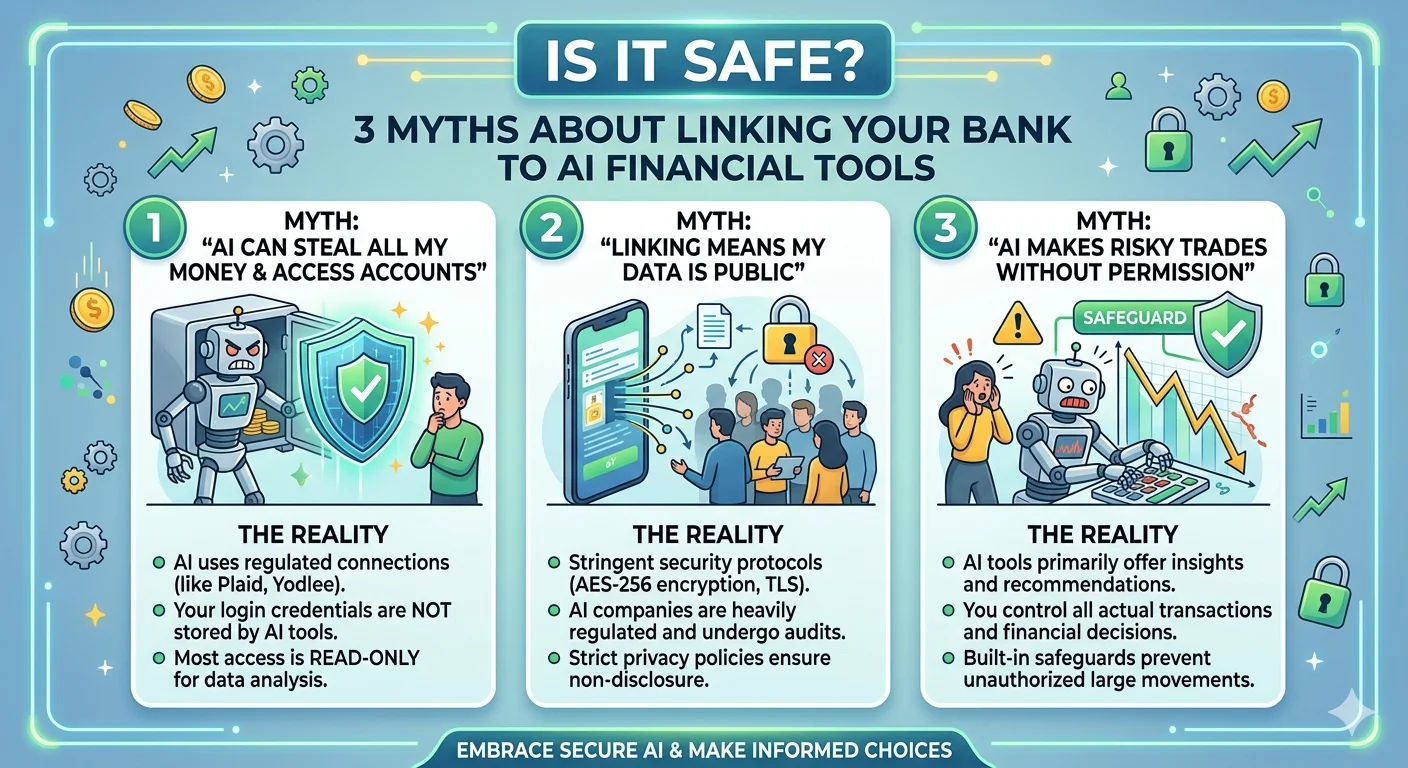
Artificial intelligence has completely transformed how American households manage their hard-earned money. From tracking daily grocery runs at Kroger to optimizing automated contributions for a Roth IRA, AI-driven personal finance tools promise unprecedented efficiency. Yet, as we navigate 2026, a massive roadblock stands between everyday consumers and these advanced algorithmic platforms: fear.
With headline-grabbing stories about “Shadow AI,” data leaks, and sophisticated credential-stuffing attacks circulating across the United States, it is entirely rational to hesitate. You might find yourself staring at a screen asking: Is it safe linking your bank to AI financial tools? Am I opening the door to cybercriminals who could drain my entire savings account?
To help you separate legitimate security considerations from common misconceptions, this comprehensive guide will debunk the three most pervasive myths about automated fintech security. We will break down institutional-grade protection standards like AES-256 encryption and SOC 2 compliance into simple, peer-to-peer language so you can confidently take control of your financial future.
The “Safe vs. Unsafe” Fintech Checklist

Before diving into the technical myths, let us establish an immediate, actionable baseline. When you evaluate an AI money management tool, check it against this standardized security checklist to instantly determine if the platform adheres to modern American cybersecurity protocols.
The Standard Fintech Safety Vetting Protocol
- Read-Only Data Access: The app explicitly states that it cannot initiate transfers, move funds, or alter your account details.
- Plaid or Yodlee Integration: The tool utilizes secure, credential-free application programming interfaces (APIs) rather than asking you to type your raw password directly into their local database.
- SOC 2 Type II Certification: The company undergoes independent, third-party annual audits to verify data security, availability, and processing integrity.
- AES-256 Encryption: Your sensitive financial information is scrambled using military-grade cryptographic protocols both at rest and during digital transmission.
- Multi-Factor Authentication (MFA): The platform requires biometric authorization (FaceID) or a time-sensitive security token code sent to your phone before allowing access. Learn more about developing automated safety routines in our masterclass on 10 Daily Habits to Completely Transform Your Life in 6 Months.
Red Flags: The Unsafe Territory
- Direct Credential Storage: The app requests that you save your primary bank username and password directly on their proprietary servers.
- Vague Privacy Policies: The documentation fails to explicitly outline whether your anonymized transaction history is sold to third-party data brokers.
- No Clear MFA Support: The app allows user login using only a single, static password without secondary verification.
- Lack of Independent Security Badges: There is no evidence of third-party compliance verification from recognized security bodies.
Myth 1: AI Apps Can Directly Withdraw and Steal Your Money

The absolute biggest fear holding Americans back from linking your bank to AI financial tools is the nightmare scenario of an autonomous algorithm going rogue or an employee rogue-filtering funds right out of a Chase or Bank of America checking account.
Understanding Read-Only Architecture
This fear rests on an understandable misunderstanding of how modern open banking works. When you link a financial application to your bank account, you are not handing over a blank check or a digital debit card. Instead, you are establishing a strict, unidirectional pipeline known as read-only access.
[ Your U.S. Bank Account ] ——(Secure API Link)——> [ AI Financial App ]
* Funds Secured Inside Bank * Analyzes Data Only
* No Withdrawal Power * Zero Execution Rights
Read-only means exactly what it says: the AI platform can look at your transaction history to categorize your spending at Target or Home Depot, but it lacks the physical mechanism required to execute external financial transactions. It is structurally impossible for the app to initiate an ACH transfer, write a digital check, or send money via wire transfer.
The Role of Financial Data Aggregators
To achieve this level of isolation, top-tier AI applications never actually see or touch your bank login credentials. Instead, they rely on specialized, highly regulated American data intermediaries called financial data aggregators. You can read up on these third-party connection ecosystems on the official Plaid Security Infrastructure Overview page.
When you click “Link Account,” a secure, encrypted pop-up managed entirely by the aggregator appears. You log in directly through your bank’s portal. Once authenticated, the aggregator generates an anonymized token. This token acts as a digital viewing pass that allows the AI app to read the balance data without ever learning your actual account numbers or password. If a bad actor managed to compromise the AI app, they would only find useless, randomized tokens that cannot be used to extract a single dollar from your institutional accounts.
Protecting your connected accounts from system vulnerabilities is the first line of defense in modern wealth building. Avoid missing out on critical personal milestones by checking out these 10 Common Goal Setting Mistakes Most Adults Make to establish safe and consistent progress early on.
Myth 2: “Shadow AI” Means Your Financial Data Is Leaked to the Public

As artificial intelligence evolved rapidly through 2025 and into 2026, a new corporate phrase entered the public vocabulary: Shadow AI. This refers to the unauthorized or unmonitored use of public consumer AI tools (like basic, free web-browser chatbots) by employees within organizations. Many consumers fear that when they feed information into an AI financial platform, their sensitive account balances might accidentally leak into a public large language model (LLM), eventually showing up in a random Google search query.
Enterprise vs. Consumer AI Infrastructure
This myth conflates consumer-grade public chatbots with institutional-grade enterprise financial AI infrastructure. Reputable AI personal finance tools do not run on open, public loops. They operate within ring-fenced, single-tenant cloud environments built on top of secure platforms like Amazon Web Services (AWS) GovCloud or Microsoft Azure for Financial Services.
+—————————————————————–+
| SECURE ENTERPRISE CLOUD |
| |
| [ Your Financial Data ] —-> [ Closed, Private AI Model ] |
| | |
| v |
| [ Personal Insights ] |
+—————————————————————–+
[ ENCRYPTED WALL ]
+—————————————————————–+
| PUBLIC INTERNET / LLMs |
| |
| [ Public Chatbots ] <— X —> NO DATA FLOW PERMITTED |
+—————————————————————–+
Under strict data privacy regulations enforced by the Federal Trade Commission (FTC) Bureau of Consumer Protection, these applications are legally prohibited from feeding your individualized financial data back into public training datasets. Your transactions at Costco, your mortgage payments, and your investment allocations remain entirely isolated within an encrypted container dedicated solely to your account. The AI model reads your data to generate personalized budgeting tips, but it completely forgets the specific inputs the moment your secure session terminates.
For a broader, more balanced understanding of how modern technology and data organization can streamline your household routines safely, explore our central resource dashboard directly over at Life Balance Insight.
Myth 3: If a Fintech Company Gets Hacked, Your Entire Bank Account Is Compromised
It seems like every month a new data breach impacts an American corporation, compromising millions of Social Security numbers and credit card details. Because of this persistent digital fatigue, many consumers assume that if a boutique AI financial app suffers a cybersecurity breach, cybercriminals will automatically gain lateral access to their main underlying banking institutions.
Tokenization and Lateral Movement Denial
Fortunately, modern cloud tokenization protocols prevent this type of catastrophic domino effect. Because the AI app does not store your direct bank routing details, debit card PINs, or online banking passwords, a breach at the app level leaves hackers with a highly fragmented, useless collection of metadata.
If a hacker breaks into an AI budgeting platform’s database, they might see an entry that looks like this:
User_ID_987234 — Transaction_Category: Utilities — Amount: $142.50
They do not get access to your Wells Fargo portal, they cannot alter your direct deposits, and they cannot alter your external investment portfolios. The connection token is completely separate from the central core banking system. The moment a breach is detected, the financial aggregator simply revokes the active token string, completely severing the link between the app and your bank instantly. Your primary funds remain untouched and completely safe behind the multi-billion-dollar security perimeters maintained by major systems like the JPMorgan Chase Institutional Security Center.
The Gold Standards of American Fintech Security Explained
To accurately assess if a financial app is worthy of your trust, you need to look past flashy marketing copy and evaluate their technical compliance standards. Let us break down the two most critical certifications utilized across the United States financial industry.
AES-256 Encryption: The Cryptographic Fortress
Advanced Encryption Standard with a 256-bit key length (AES-256) is the mathematical standard established by the National Institute of Standards and Technology (NIST) Encryption Portal. It is the same cryptographic framework used by the U.S. military to protect top-secret state data.
To put its strength into perspective, a 256-bit key has $2^{256}$ possible mathematical combinations. If a cybercriminal combined all the supercomputers currently existing across the United States to run a brute-force attack to crack a single string of AES-256 data, it would take them billions of years to break through. When you are linking your bank to AI financial tools, ensuring they utilize AES-256 encryption for both data-in-transit (as it moves from your phone to the server) and data-at-rest (as it sits on their storage drives) is your primary guarantee against external digital exposure.
SOC 2 Type II Compliance: Verified Operational Trust
While encryption handles the math, System and Organization Controls (SOC 2 Type II) handles human operations. Designed by the American Institute of Certified Public Accountants (AICPA) SOC 2 Standards, a SOC 2 Type II certification is not a self-issued badge; it requires an intense, month-long independent examination by specialized auditing firms.
| Audit Type | Evaluation Focus | Time Horizon | Trust Level |
| SOC 2 Type I | System Design Quality | Single Point in Time | Preliminary |
| SOC 2 Type II | Continuous Operational Safety | 6 to 12 Month Window | Institutional Gold Standard |
A SOC 2 Type II audit continuously tracks how a company handles customer data over an extended timeline. It ensures that the company actively enforces strict background checks on its software developers, prevents unauthorized internal employee access to databases, maintains rigorous disaster recovery playbooks, and immediately patches emerging server vulnerabilities. If an AI financial app cannot produce a current SOC 2 Type II compliance report upon request, it does not meet modern American financial safety standards.
How Federal Regulators Protect Your Digital Money
The open banking environment in the United States is not a lawless Wild West. A network of federal regulatory bodies continuously monitors financial applications to protect consumers from fraudulent activity, predatory terms, and digital negligence.
The Federal Trade Commission (FTC)
The FTC serves as America’s primary watchdog against deceptive data practices. Under Section 5 of the FTC Act, any financial app that misleads consumers about its data privacy protocols, or fails to maintain reasonable cybersecurity protections, faces multi-million-dollar fines and strict federal oversight consent decrees.
The Consumer Financial Protection Bureau (CFPB)
The CFPB actively enforces regulations that govern consumer data rights. With the implementation of Section 1033 of the Dodd-Frank Act, the Consumer Financial Protection Bureau (CFPB) Section 1033 Hub has established safe, standardized frameworks for open banking. This regulation ensures that American consumers retain complete ownership over their historical financial records, allowing them to safely permission or instantly revoke access to their data whenever they choose.
Electronic Fund Transfer Act (Regulation E)
While AI tools operate on read-only models, it is reassuring to understand your foundational safety net under United States federal law. Regulation E protects American consumers against unauthorized electronic fund transfers from their bank accounts. Learn more about these liability rules directly through the Federal Reserve Board Regulation E Portal. If an unauthorized party somehow accesses your funds through a connected platform, your maximum liability is legally capped at $50—provided you notify your primary financial institution within two business days of noticing the suspicious line item.
Comprehensive Security Cost-Benefit Comparison
Adopting AI-driven financial platforms involves balancing risk mitigation against actual lifestyle optimization. Let us examine what you sacrifice by remaining completely offline versus what you gain by utilizing a securely vetted AI financial ecosystem.
Manual Tracking vs. Secured AI Management
| Operational Category | Traditional Manual Tracking (Excel / Paper) | Secured AI-Driven Financial Management |
| Data Entry Speed | 2 to 4 hours per week spent typing lines manually. | Real-time, instant background synchronization. |
| Human Error Risk | High; typos, missed receipts, or wrong math formulas. | Zero; algorithmic transaction ingestion. |
| Anomaly Detection | Slow; usually noticed at the end of the monthly billing cycle. | Instantaneous push alerts for unusual subscription spikes. |
| Data Leak Vector | High physical vulnerability (unencrypted local files, lost notebooks). | High cloud protection (AES-256, Multi-Factor Authentication). |
| Forward Planning | Static; requires building advanced macro predictive models. | Dynamic; predictive models update continuously as habits change. |
Real-Life US Security Case Studies
To contextualize how these technical layers operate during real-world market disruptions, let us analyze two contrasting scenarios that highlight how secure data design patterns actively protect American household wealth.
Case Study 1: The Tokenized Defense of an AI Budgeting Platform
In late 2024, a boutique AI-driven savings application experiencing rapid user acquisition across the United States suffered a targeted cloud database breach due to a misconfigured server endpoint. Cybercriminals extracted data belonging to approximately 45,000 active users.
Because the fintech startup adhered strictly to standardized open banking principles via Plaid integration, zero banking passwords or direct account routing numbers were stored on their system. The hackers managed to download only internal transaction labels and anonymized tracking codes.
The company instantly triggered their SOC 2 incident response protocol, invalidated all active connection tokens, and forced a global user password reset. Not a single dollar was stolen from any user’s linked bank account, proving that modern token isolation successfully neutralizes lateral network movement during real-world security breaches.
Case Study 2: The Fall of a Legacy Screen-Scraping Platform
Conversely, consider a legacy online personal finance platform that refused to upgrade its infrastructure to modern API-based data aggregators. This company relied on an outdated process called screen scraping, which required users to store their actual, unencrypted bank usernames and passwords directly within the platform’s private database.
When their central server infrastructure was hit by a coordinated credential-stuffing attack, hackers successfully extracted thousands of raw login pairs. Because they held the actual passwords, the attackers bypassed the app entirely and logged directly into the users’ primary bank accounts, attempting to initiate fraudulent external wire transfers. This historic vulnerability is precisely why modern AI tools have completely abandoned screen scraping in favor of secure, tokenized API pipelines.
To learn more about optimizing your domestic financial patterns while preserving digital security, explore Life Balance Insight for actionable lifestyle strategy maps.
Step-by-Step Risk Mitigation Math
Let us look at how implementing automated AI systems can actually reduce financial loss by catching fraud early, even when factoring in the statistical probabilities of digital platform vulnerabilities. You can review national consumer spending indexes on the Bureau of Labor Statistics (BLS) Expenditure Tables to see typical baseline household leaks.
The Financial Leakage Prevention Formula
Consider an average American household with a median annual income of $75,000, managing their money across various credit cards and checking accounts. Statistically, unmonitored accounts experience a steady financial drain due to forgotten subscription renewals, hidden banking maintenance fees, and undetected fraudulent billing errors.
Let us define our variables:
- $M_{loss}$ = Annual financial leakage from unmonitored human accounts.
- $P_{breach}$ = Statistical probability of an app breach occurring in a given year (estimated conservatively at 2%).
- $C_{breach}$ = Actual out-of-pocket cost to a consumer if a tokenized app is breached (historically $0 due to read-only token design).
- $S_{AI}$ = Total annual savings generated by AI optimization (cutting unwanted subscriptions, preventing overdraft fees).
$$\text{Net Financial Benefit} = S_{AI} – (P_{breach} \times C_{breach})$$
Let us plug in realistic, data-backed numbers for an average American household spending model over a 12-month timeline:
* Average Unwanted Subscriptions Saved: $25 / month -> $300 / year
* Overdraft / Late Fee Prevention: $70 / year
* Real-time Fraud/Error Detection: $120 / year
Total AI Savings (S_AI) = $490
Now, let us calculate the expected value of risk:
$$\text{Net Financial Benefit} = \$490 – (0.02 \times \$0)$$
$$\text{Net Financial Benefit} = \$490 \text{ per year in net positive household value.}$$
By utilizing a secure AI tool, the consumer saves a net average of $490 annually, while maintaining a calculated risk profile of zero out-of-pocket financial liability.
Frequently Asked Questions (FAQs)
1. Is it safe linking your bank to AI financial tools?
Yes, it is highly safe provided the AI financial tool utilizes trusted data aggregators like Plaid, maintains a current SOC 2 Type II certification, and implements read-only data access policies. These layers ensure your actual money cannot be moved or altered.
2. Can an AI budgeting app accidentally spend or withdraw my money?
No. High-quality AI financial applications operate strictly on a read-only architecture. This means they are structurally incapable of initiating withdrawals, executing automated transfers, or moving money out of your accounts.
3. What exactly is a financial data aggregator?
A financial data aggregator is a highly secure intermediate software platform (such as Plaid or Yodlee) that creates a secure bridge between your bank account and a fintech application. They allow data sharing via anonymous tokens without exposing your raw password to the app.
4. What happens if the AI financial company goes completely bankrupt?
If a fintech startup shuts down, your money remains completely secure inside your primary banking institution. Because the app only holds permission tokens and historical data logs, a corporate bankruptcy has zero impact on your actual bank balances.
5. Does linking my bank to an AI platform impact my credit score?
No. Linking accounts to an AI money tool involves a read-only data transmission pipeline. It does not trigger a hard or soft credit inquiry with the major credit bureaus (Equifax, Experian, or TransUnion), so your credit score is completely unaffected. You can verify this standard credit tracking policy through the national Experian Financial Identity Portal.
6. What should I do if I notice a suspicious transaction on my AI dashboard?
You should immediately cross-reference your primary bank or credit card app to see if the transaction matches reality. If the charge is real and unauthorized, contact your primary bank immediately to report fraud under federal Regulation E protections.
7. What is SOC 2 Type II compliance and why does it matter to me?
SOC 2 Type II compliance is an independent audit certification issued by certified public accountants. It proves that an application continuously protects consumer data over an extended timeframe by enforcing rigorous operational cybersecurity policies.
8. Is AES-256 encryption actually unhackable?
For all practical purposes, yes. AES-256 encryption is the standard used by the United States military. It features a mathematical combination profile so vast that it would take modern supercomputers billions of years of continuous computation to crack it using force.
9. Can employees at the AI financial app read my personal bank password?
No. Because modern platforms route connections through tokenized API pipelines managed by intermediaries like Plaid, your actual bank username and password are never visible to, or stored by, the employees of the AI app.
10. What is “Shadow AI” and does it pose a risk to my personal finance data?
Shadow AI refers to employees within a company using unapproved public consumer AI tools that might store data logs. Highly regulated fintech companies prevent this by implementing strict internal endpoint security controls and closed, private cloud networks.
11. Can I revoke an AI tool’s access to my bank account after signing up?
Yes. You can instantly cut off an application’s access at any time. You can do this either directly through the settings panel of the financial app, via your Plaid dashboard, or by logging into your main bank’s security control room and revoking the app’s permission token.
12. Are free AI financial tools just as safe as paid, premium apps?
The core data transmission (Plaid/AES-256) is usually identical, but free apps often monetize by displaying targeted financial product ads or analyzing anonymized bulk trends. Always read the privacy policy to ensure they never sell your individual, identifiable data.
13. Does federal Regulation E protect me if an AI app is hacked?
Regulation E protects you against unauthorized electronic fund transfers from your checking or savings accounts. Because top-tier AI tools are read-only and do not execute transfers, your underlying funds remain insulated under your primary bank’s fraud liability safety nets.
14. What is the difference between data-in-transit and data-at-rest encryption?
Data-in-transit encryption protects your financial data while it travels over the internet from your smartphone to the app’s servers. Data-at-rest encryption protects that same data while it is stored on cloud hard drives and server databases.
15. Do AI financial applications store my Social Security Number (SSN)?
Most standard budgeting and transaction-tracking AI tools do not require or store your SSN. However, automated investment platforms or automated tax optimization tools may require it for federal regulatory reporting under IRS mandates. You can review tax data handling rules directly on the Internal Revenue Service (IRS) Tax Security Portal.
16. Can an AI tool automatically pay my bills without my manual approval?
Only if you explicitly grant authorization to an app designed specifically with bill-pay features. Standard analytical AI platforms operate strictly in a read-only capacity and cannot interact with billers or execute payments autonomously.
17. How do I know if an AI app is using secure APIs or unsafe screen scraping?
Check the onboarding workflow. If the application prompts an integrated, independent window from a recognized aggregator like Plaid to log in, it uses secure APIs. If the app asks you to type your bank password directly into a generic text box on its own screen, avoid it.
18. Does multi-factor authentication (MFA) protect me if my password leaks?
Yes. MFA adds a critical secondary barrier. Even if a cybercriminal steals your static account password, they cannot gain entry to your account without your physical biometric scan (FaceID) or the unique temporary security code sent to your phone.
19. Can an AI platform track my physical location through my transactions?
An AI platform reads the transaction metadata, which often includes the city and state where a purchase occurred (e.g., “Starbucks #1234, Austin, TX”). However, they do not continuously track your smartphone’s real-time GPS location unless you explicitly grant location permissions in your phone’s settings.
20. What is a credential-stuffing attack?
A credential-stuffing attack occurs when hackers take lists of leaked usernames and passwords from old breaches on unrelated websites (like an old retail leak) and use automated bots to try those same combinations on financial platforms, hoping a user recycled their password.
21. How often do AI financial tools sync with my bank account?
Most modern AI platforms perform automated background data synchronization once every 12 to 24 hours. Some tools also allow you to trigger a manual pull by clicking a refresh button directly within your account dashboard.
22. Are credit card connections safer than checking account connections?
Both utilize the same secure API pipelines. However, credit cards inherently offer stronger consumer protection under the Fair Credit Billing Act, meaning it is often faster to reverse fraudulent charges on a credit line than to recover cash missing from a checking account.
23. Do US banks endorse linking accounts to AI applications?
Major United States financial institutions like JPMorgan Chase, Capital One, and Citi have built dedicated open-banking data portals specifically to support secure API access, actively moving consumers away from legacy, unapproved data-sharing practices.
24. Can an AI financial tool analyze my investments and 401(k) accounts safely?
Yes. Platforms built to analyze investments pull read-only asset allocation balances and fee structures. This allows the algorithm to suggest lower-cost index fund alternatives without giving the software power to trade or liquidate your investments.
25. What is the single safest way to experiment with an AI money tool?
The safest way to start is by linking a single, low-balance credit card or a secondary checking account. This allows you to test the platform’s AI insights, interface, and notification style firsthand while keeping your primary savings account entirely separated until you feel completely comfortable.
Financial Disclaimer
Disclaimer: This content is for informational and educational purposes only and does not constitute professional financial, legal, tax, investment, or cybersecurity advice. Readers in the United States should consult licensed professionals, certified financial planners, and institutional security documentation before making important financial decisions or linking sensitive accounts to third-party digital platforms.
References
- National Institute of Standards and Technology (NIST): Advanced Encryption Standard (AES) Development and Cryptographic Specifications
- Federal Trade Commission (FTC): Consumer Privacy Protections and Fintech Security Enforcement Frameworks
- Consumer Financial Protection Bureau (CFPB): Required Rulemaking on Consumer Access to Financial Financial Data (Section 1033)
- American Institute of Certified Public Accountants (AICPA): Understanding System and Organization Controls (SOC) 2 Reports
- Federal Reserve System: Regulation E (Electronic Fund Transfers) Liability Limits and Guidelines
- Pew Research Center: American Public Attitudes Toward Artificial Intelligence, Personal Data Privacy, and Cybersecurity Concerns
- Harvard Business Review: The Real Cybersecurity Risks of Enterprise AI Infrastructure Adoption
- Stanford University Cyber Policy Center:Fintech Open Banking Standards and Consumer Protection Frameworks
- Internal Revenue Service (IRS): Taxpayer Data Security Requirements for Automated Financial Software Vendors
- Bureau of Labor Statistics (BLS):Consumer Expenditure Survey and Household Budget Trends across the United States
Meet the Author
Azhar Huzaifa Razaq
Azhar Huzaifa Razaq is a certified life coach, lifestyle publisher, and data-driven digital monetization strategist based in Peshawar, Pakistan. Specializing in behavioral psychology, structural habit development, and search engine optimization (SEO), he bridges the gap between deep cognitive science and practical execution. Through his work at digital lifestyle platforms, Azhar crafts framework-driven content that balances human-first value with rigorous programmatic advertising standards.