
The Predictable Income Myth: Why Traditional Budgeting Fails the Non-W-2 Workforce
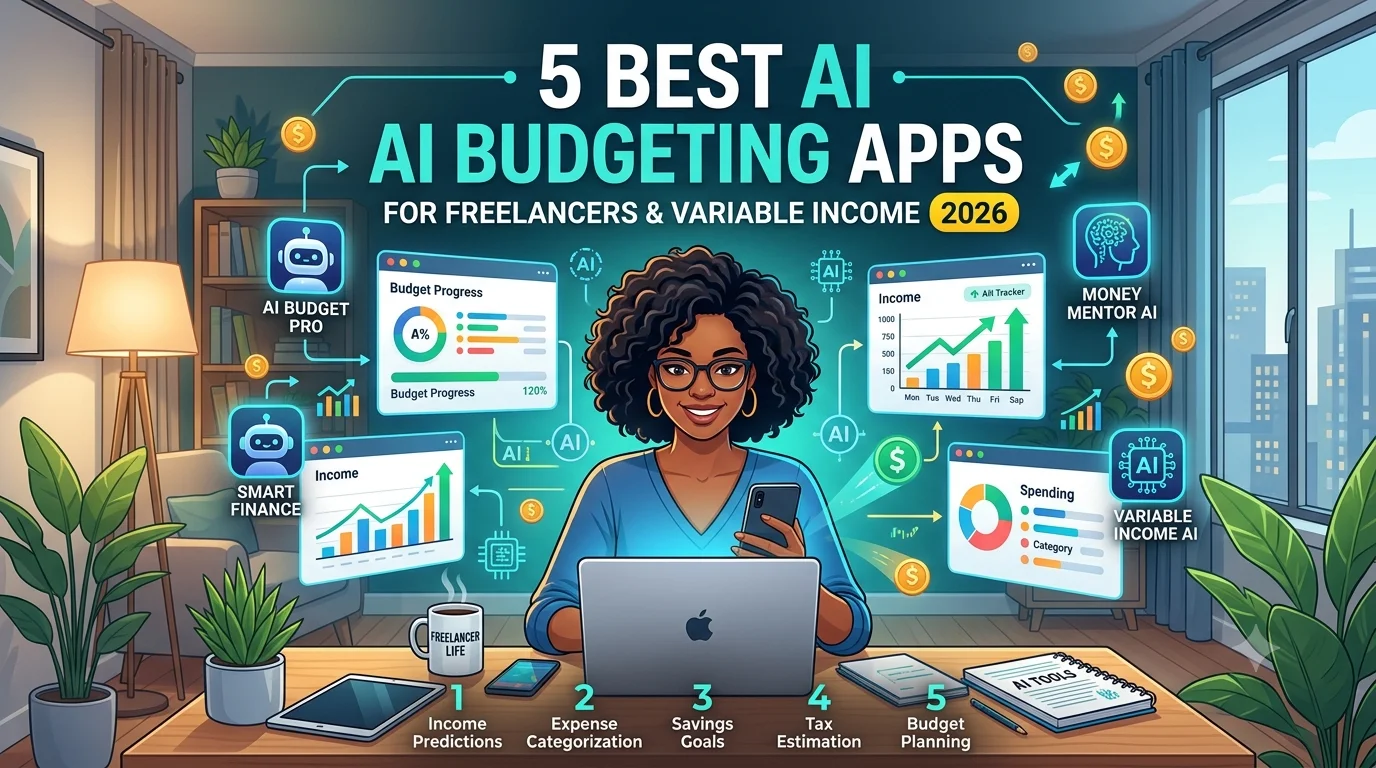
5 Best AI Budgeting Apps:
Traditional personal finance tools are built around an assumption that no longer holds true for millions of Americans: the steady, predictable bi-weekly W-2 paycheck. For the classic corporate employee, budgeting is a straightforward arithmetic exercise. Money flows in on a fixed schedule, and fixed expenses flow out.
But for independent contractors, solopreneurs, gig workers, and variable-income households, income looks like an EKG monitor—dramatic spikes followed by prolonged flatlines.
According to data from the Freelancers Union Independent Worker Economic Impact Analysis and the U.S. Bureau of Labor Statistics, over 60 million Americans engage in independent work. When you try to force an irregular, volatile income stream into a rigid, backward-looking budgeting application, the system shatters.
Traditional zero-based budgeting apps require you to know exactly how much you earned this month to assign every dollar a job. If your client pays 45 days late, or your seasonal contract ends abruptly, a traditional framework leaves you staring at red, broken dashboards.
The core vulnerability of older personal finance software is its reactive nature. It tracks what you already spent, rather than forecasting what you will receive. This forces freelancers into a continuous defensive posture, reacting to crises rather than executing an intentional financial strategy. By prioritizing tools for digital automation, modern workers can flip this script from defense to offense.
The Psychology of Scarcity: How Income Volatility Drains Cognitive Bandwidth

Managing an irregular income is not just an accounting challenge; it is an exhausting psychological burden. Behavioral economists at Harvard and Princeton have highlighted the “scarcity mindset”—a cognitive phenomenon where the immediate stress of financial instability reduces an individual’s effective IQ by up to 13 points. When you are constantly worrying about whether next month’s invoices will cover your structural overhead, your brain lacks the bandwidth to plan for long-term goals like a Roth IRA or a comprehensive high-yield savings account (HYSA) buffer.
This anxiety triggers two destructive financial behaviors:
- The Feast-or-Famine Spending Cycle: During high-earning months (“feast” phases), individuals experience a psychological release of tension. The relief often leads to lifestyle creep or impulse spending, under the assumption that the good times will last. When the inevitable “famine” phase hits, they are caught without cash reserves, forcing them to rely on high-interest credit cards, damaging their FICO credit scores. Understanding the psychology of impulse spending is crucial to short-circuiting this destructive pattern.
- Financial Paralysis: Out of fear of upcoming dry spells, some freelancers refuse to invest back into their businesses, avoid paying their quarterly estimated taxes on time according to IRS Form 1040-ES Withholding Guidelines, or skip routine health checkups, which compromises their long-term economic and mental clarity.
To break this loop, self-employed individuals need tools that mitigate cognitive fatigue by handling prediction and tax withholding automatically, paving the way for overcoming money anxiety for good.
The AI Paradigm Shift: How Predictive Insights Stabilize Irregular Cash Flow
The introduction of artificial intelligence into fintech has changed personal money management for non-traditional earners. Rather than relying on simple rule-based sorting, modern AI budgeting applications use machine learning algorithms and advanced statistical modeling to address variable revenue.
[Raw Bank Data] ---> [Machine Learning Categorization] ---> [Rolling Average Calculations] ---> [Predictive Cash Flow Forecast]
These platforms process financial management through several key AI components:
- Predictive Cash Flow Modeling: By running deep regressions on your historic bank data, payment processors (like Stripe or PayPal), and invoicing patterns, the AI builds a forward-looking 30, 60, and 90-day cash flow curve. It identifies the true “baseline structural survival number” of your household.
- Behavioral Pattern Recognition: The AI notes when client payouts typically arrive, tracks your variable business expenses, and flags hidden recurring subscriptions that normal trackers miss. Establishing clear daily routines for remote workers can help complement these automated data points by stabilizing operational workflows.
- Automated Tax and Reserve Splitting: Modern AI systems can calculate your estimated tax liabilities in real time based on net income metrics, advising you exactly what to transfer to an isolated account so you are not caught off guard by federal deadlines.
The Best AI Budgeting Apps for Freelancers in 2026: Deep-Dive Reviews

Choosing a tool depends on your primary financial pain point. Below are detailed, objective evaluations of the leading AI-driven options designed to handle irregular cash flows in 2026.
1. Waypoint Budget
Best Overall for True LLM-Powered Financial Coaching
Waypoint Budget is built around a large language model framework, making it highly effective for variable earners who prefer an interactive experience over dense, complex spreadsheets.
- Ideal User Profile: Freelancers who experience heavy money anxiety and want a conversational assistant to analyze patterns and suggest adjustments.
- Key AI Feature: The Money Coach feature. This is a context-aware financial advisor that securely scans your transaction history. You can ask it questions like, “Based on my last three months of irregular income, can I safely afford a $1,200 equipment upgrade without draining my tax reserve?” It calculates answers instantly based on your rolling revenue averages.
- Pricing: Free tier available (includes 5 AI coach interactions per day); Plus Plan is $7.99 per month for unlimited access.
- Pros: Highly responsive natural language processing; excellent at breaking down confusing cash flow patterns; accessible free entry point.
- Cons: Lacks deep multi-currency support for international contractors; the dashboard layout is very simple, which might disappoint data-hungry users.
2. Copilot Money
Best for High-Income Freelancers with Apple Ecosystem Integration
Copilot Money offers an advanced machine-learning engine wrapped in a highly polished user interface, optimized specifically for Mac and iOS environments.
- Ideal User Profile: Self-employed professionals who manage a mix of business revenue, heavy credit card usage for rewards, and diverse investment portfolios.
- Key AI Feature: Smart Categorization Engine. Copilot tracks your adjustments over time and adapts to your exact business setup. It automatically parses irregular contractor write-offs from personal spending with near-perfect accuracy after an initial learning phase.
- Pricing: $13 per month or $119 annually (No free tier, trial options only).
- Pros: Outstanding UI/UX; direct integrations with Amazon and Venmo; strong predictive tracking for recurring subscriptions and annual renewals.
- Cons: Restricted entirely to Apple platforms (no Android version); requires a paid subscription from day one.
3. Cashflowy
Best for Solopreneurs Managing Combined Business and Personal Expenses
Cashflowy addresses a major issue for freelancers: the messy crossover between business operations and household spending.
- Ideal User Profile: Independent service providers, coaches, and consultants who need clear foresight on upcoming cash balances rather than reactive monthly reports.
- Key AI Feature: Forward-Looking Cash Position Projections. Cashflowy aggregates open invoices, scheduled client payments, and fixed operating costs to generate a dynamic 60-day visual graph of your cash runway.
- Pricing: $10 per month (includes real-time bank syncing via Plaid).
- Pros: Excellent forecasting visualizer; built-in tax estimation layers; rapid setup under 15 minutes.
- Cons: Minimal lifestyle or habit-building gamification elements; interface leans toward a clean business B2B style.
4. Cleo
Best for Younger Freelancers and Gig Workers Facing Impulse Spending Issues
Cleo replaces standard personal finance dashboards with a conversational chatbot interface designed to curb emotional spending during your “feast” months.
- Ideal User Profile: Gen Z and millennial gig workers who struggle with budget discipline and need direct accountability.
- Key AI Feature: Conversational Guardrails. Cleo uses AI to review your account balance daily and will literally “roast” or praise your spending habits upon request, highlighting cash trajectory changes before you overspend.
- Pricing: Core features are free; Cleo Plus is $5.99 per month (unlocks credit building and cash advances).
- Pros: Strong psychological intervention against impulse purchases; highly engaging text interface.
- Cons: Lacks sophisticated long-term net worth, investment, or multi-account balance sheet analytics.
5. Monarch Money
Best for Variable Income Households and Collaborative Budgeting
Monarch Money is an incredibly robust, stable, and highly customizable personal finance platform that serves as an excellent tool for couples managing uneven household income.
- Ideal User Profile: Dual-income households where one or both partners are freelancers, requiring clean collaboration and multi-account mapping.
- Key AI Feature: Flexible Forecast Modeling. Monarch allows you to build dynamic budgets based on monthly rolling average projections. Its AI monitors pattern changes across multiple linked networks (Plaid, MX, Finicity) to warn you when current trajectories mismatch your historical trends.
- Pricing: $14.99 per month or $99.99 annually.
- Pros: Excellent collaboration features; allows data sharing with financial advisors or partners; multi-network backend ensures reliable bank connections.
- Cons: Higher price point; steep learning curve for users who just want basic expense tracking.
Comprehensive Data Breakdowns and Comparison Matrices

To help clarify your options, here is a detailed breakdown of how these top platforms compare in core functionality, specific AI features, and operational costs.
Operational Cost and Platform Matrix
| Budgeting App | Monthly Cost | Annual Cost | Platform Compatibility | Target Audience |
| Waypoint Budget | Free / $7.99 | $95.88 | Web, iOS, Android | Anxious freelancers seeking advice |
| Copilot Money | $13.00 | $119.00 | iOS, Mac, iPad, Web | Apple power users, high earners |
| Cashflowy | $10.00 | $120.00 | Web, Mobile Responsive | Solopreneurs with open invoices |
| Cleo | Free / $5.99 | $71.88 | iOS, Android, Web | Gig workers prone to impulse buying |
| Monarch Money | $14.99 | $99.99 | Web, iOS, Android | Dual-income variable households |
AI Feature Depth Comparison
| App | Core AI Technology Type | Automatic Tax Planning Support | Partner Collaboration Features | Cash Flow Curve Projection |
| Waypoint Budget | Conversational LLM Model | Moderate (Via Chat Advice) | No | High |
| Copilot Money | Machine Learning Sorting | Low (Categorization Only) | No | Moderate |
| Cashflowy | Predictive Data Modeling | High (Continuous Sync) | Yes (For Accountant) | Very High |
| Cleo | Chatbot Interface | Low | No | Low |
| Monarch Money | Pattern Analytics | Moderate (Flexible Goals) | High (Dual Access) | High |
Real-World US Case Studies and Scenarios
To see these financial principles in action, let’s explore how two typical American variable income scenarios use predictive AI budgeting tools to stabilize their personal finances.
Case Study 1: The Solo Freelancer (The Feast-or-Famine Loop)
- Profile: Sarah, a freelance graphic designer based in Austin, Texas. Her monthly revenue swings wildly between $3,500 and $11,000 depending on client retainers and project completions.
- The Problem: During an $11,000 month, Sarah would feel wealthy, spend heavily on dining out, and skip saving. The following month, her income would drop to $3,500, leaving her short on rent and forced to carry a balance on her credit card, dragging down her FICO score.
- The AI Solution: Sarah focused on building automated money habits using Cashflowy and Waypoint Budget. Cashflowy automatically analyzed her historic Stripe data, calculated her true rolling 12-month average monthly income ($5,800), and mapped her baseline structural survival cost ($4,100). Waypoint’s Money Coach advised her to treat the $5,800 as her fixed “salary.” In her high months, the excess cash was automatically swept into high-yield savings account strategies. During low months, she pulled from the HYSA buffer to maintain her baseline, completely eliminating her credit card dependency.
Case Study 2: The Variable Income Household
- Profile: Mark and Elena, a married couple in Chicago, Illinois. Mark works a stable W-2 job earning $4,500 per month. Elena is a self-employed real estate agent whose commission checks drop unpredictably ($0 some months, $15,000 in others).
- The Problem: They struggled to manage household expenses together. Traditional apps marked them as constantly over-budget or under-budget, making financial tracking a source of marital arguments.
- The AI Solution: They linked all accounts via Monarch Money. The platform’s flexible forecasting allowed them to map Mark’s stable salary directly to their critical fixed overhead (mortgage, health insurance, student loans). Elena’s irregular commissions were funneled through an AI tracking rule that auto-allocated 30% to a separate business account for quarterly estimated taxes, 40% to their emergency reserve, and left the remainder for variable lifestyle spending. This structured layout provided mental clarity through organization, removing the guesswork and smoothing their household cash flow.
The Freelance Financial Math: Predictive Cash Flow Formulas

To truly master an irregular income, you have to understand the mathematical mechanics behind predictive cash flow management. AI tools run these calculations in the background, but understanding the core math helps you stay in control of your financial strategy.
1. The Rolling Baseline Revenue Formula
Instead of budgeting around what you earned last week, you must build your spending plans using a 12-month trailing rolling average, adjusted down by a conservative safety margin ($15\%$).
$$R_{budget} = \left( \frac{\sum_{i=1}^{12} I_i}{12} \right) \times 0.85$$
Where:
- $I_i$ is your total net income for a specific month.
- $0.85$ represents a $15\%$ discount factor to safely protect against unexpected dry spells or client churn.
If your total net income over the past 12 months was $72,000, your mathematical baseline monthly income is $6,000. Applying the safety margin gives you a reliable budgeting baseline of $5,100 per month. Adopting these calculations is a foundational component of mindful spending frameworks that preserve long-term wealth.
2. The True Cash Runway Calculation
When your income is highly volatile, your financial security is measured in time, not just your checking account balance. Your runway indicates how many months your household can survive if all your revenue streams completely dried up today. This approach is central to achieving career and life balance without constant professional burnout.
$$\text{Runway (Months)} = \frac{\text{Liquid HYSA Balance} + \text{Available Net Business Cash}}{\text{Baseline Structural Survival Expenses}}$$
Expected Financial Stabilization Projections
When you switch from reactive tracking to a predictive AI rolling average model, your emergency fund growth follows an accelerated trajectory due to reduced emotional overspending. Maintaining maximizing daily focus on your core business goals becomes much easier when this cash cushion is established.
Months Using System:   [0]----> [3]----> [6]----> [12]
Emergency Fund (Days): [15]---> [45]---> [90]---> [180]
This trajectory demonstrates how consistently saving your excess revenue during high-income months quickly builds a highly stable, reassuring cash cushion.
Frequently Asked Questions
1. Why do traditional budgeting apps fail if I have an irregular income?
Traditional budgeting applications require a predictable income stream to allocate funds in advance. When your revenue fluctuates month-to-month, these static platforms show false deficits or artificial surpluses, which fails to help you manage cash flow during lean periods.
2. How does an AI budgeting app predict my future cash flow?
AI budgeting tools evaluate your historical deposit intervals, invoice dates, payment processing histories, and seasonal fluctuations to map out a forward-looking cash flow forecast.
3. Is it safe to connect my freelance business bank accounts to these apps?
Yes. Reputable personal finance apps use bank-level encryption standards and link through secure, read-only aggregators like Plaid, Finicity, or MX, meaning they never store your actual login credentials.
4. Can AI help me calculate my quarterly estimated taxes?
Platforms like Cashflowy run real-time net profit analyses and use current IRS tax brackets to estimate your ongoing quarterly liabilities, helping you set aside enough cash for tax season.
5. What is a “baseline structural survival number”?
This is the absolute minimum dollar amount required each month to cover your core non-discretionary expenses, such as housing, utilities, basic groceries, insurance, and minimum debt payments.
6. Should I mix my personal and business budgets in a single AI app?
It is best to use an app like Monarch Money or Cashflowy that allows you to tag and isolate business transactions from personal ones, keeping your personal budget clean while maintaining accurate records for tax write-offs.
7. How long does it take for an AI app to learn my spending habits?
Most machine learning categorization engines need roughly 30 to 60 days of transaction data and occasional manual adjustments to reach high automation accuracy.
8. What is the difference between conversational AI and predictive AI in finance?
Conversational AI uses large language models to let you talk to an interactive financial coach. Predictive AI uses statistical algorithms to analyze data patterns, categorize expenses, and project cash flow charts.
9. Can these apps track income from multiple sources like Stripe, PayPal, and Upwork?
Yes, most premium apps link directly to multiple bank accounts and major payment platforms, consolidating all your incoming revenue into one centralized workspace.
10. Do any AI budgeting apps offer features specifically for couples?
Monarch Money is highly regarded for collaborative household budgeting, offering separate login credentials while giving both partners full visibility into shared financial goals.
11. Is there a completely free AI budgeting app available?
Waypoint Budget provides a robust free tier that gives users access to its core tracking tools and up to five daily interactions with its LLM-powered Money Coach.
12. How does the feast-or-famine cycle affect mental health?
Income volatility can trigger continuous financial anxiety and cognitive fatigue. This constant stress can lead to emotional overspending when cash is abundant and panic during dry spells.
13. Can an AI budgeting tool help me improve my FICO credit score?
By forecasting upcoming lean months, the AI helps ensure you always have enough cash on hand to cover your bills on time, preventing missed payments that could damage your credit score.
14. What should I do with excess money during a high-income month?
You should transfer the surplus directly into a dedicated high-yield savings account (HYSA) to serve as a cash cushion for future low-income months, rather than letting it sit in your checking account where it might get spent.
15. Do these personal finance apps support Android devices?
Most options, including Waypoint Budget, Monarch Money, and Cleo, offer excellent Android apps. However, Copilot Money is currently focused primarily on the Apple ecosystem.
16. How do AI budgeting tools handle annual or irregular business expenses?
The AI scans your financial history for annual recurring charges—like software subscriptions or insurance premiums—and factors those upcoming costs into your monthly spending plan automatically.
17. Can I use these apps if I am a part-time freelancer with a regular W-2 job?
These platforms are highly effective for side hustlers, as they easily separate your predictable W-2 paychecks from your fluctuating freelance income.
18. What happens if Plaid fails to connect to my small local credit union?
Platforms like Monarch Money offer alternative connection networks like MX and Finicity, which significantly increases the likelihood of successfully linking to smaller regional banks.
19. How do AI financial tools protect my data privacy?
Top personal finance platforms maintain a strict data privacy stance, ensuring your financial information is never sold to third-party advertisers or insurance companies.
20. Can an AI money coach replace a certified human financial planner?
While an AI coach provides excellent day-to-day transaction insights and cash flow analysis, it cannot replace a licensed human professional for complex estate planning, advanced tax strategies, or customized investment management.
21. What is a “rolling average” budget?
A rolling average budget calculates your monthly spending limits using your average net income over the past several months, rather than relying on a single month’s earnings.
22. Can these apps track my retirement contributions to a Roth IRA or Solopreneur 401(k)?
Yes, premium budgeting applications track investment account balances alongside your standard bank accounts, giving you an accurate look at your total net worth over time.
23. Do AI budgeting tools automatically negotiate down my monthly bills?
Apps like Rocket Money offer bill negotiation services, though they typically take a percentage of the annual savings they secure for you.
24. How do I handle client invoices that are paid 60 or 90 days late?
Predictive forecasting tools include these delayed payment windows in your cash runway charts, helping you see exactly how long your existing cash reserves will last.
25. What is the most common mistake freelancers make when budgeting?
The biggest mistake is treating a massive, single-month invoice payout as immediately spendable cash, rather than setting aside reserves for taxes and spreading the remainder across lean months.
References
- Bureau of Labor Statistics, U.S. Department of Labor, Occupational Outlook Quarterly, Self-Employed and Independent Work Trends Study. Available at bls.gov.
- Internal Revenue Service, Publication 505: Tax Withholding and Estimated Tax, U.S. Department of the Treasury. Available at irs.gov.
- Mullainathan, S., & Shafir, E. (2013). Scarcity: Why Having Too Little Means So Much. Time Books, Harvard/Princeton Academic Reprints. Available at harvard.edu.
- Federal Reserve Board, Report on the Economic Well-Being of U.S. Households, Household Cash Flow Volatility Section. Available at federalreserve.gov.
- Pew Research Center, The State of Gig Work and Freelance Economics in America. Available at pewresearch.org.
- Consumer Financial Protection Bureau, Financial Well-Being in America: Volatility and Liquid Savings Buffers. Available at consumerfinance.gov.
- Monarch Money Security & Plaid Data Integration Connectivity Framework Documentation (2026). Available at monarchmoney.com.
- Waypoint Budget AI Architecture and LLM Money Coach Integration whitepaper specifications (2026). Available at waypointbudget.com.
- Copilot Money User Onboarding and Machine Learning Intelligence Feature Guide (2026). Available at copilot.money.
- U.S. Small Business Administration, Financial Management and Cash Flow Analysis for Independent Contractors. Available at sba.gov.
Regulatory and Informational Disclaimer
Disclaimer: This content is for informational and educational purposes only and does not constitute financial, legal, tax, or professional advice. Readers in the United States should consult licensed professionals, including Certified Public Accountants (CPAs) and Certified Financial Planners (CFPs), before making important financial decisions or implementing new tax withholding strategies.
Meet the Author
Azhar Huzaifa Razaq
Azhar Huzaifa Razaq is a certified life coach, lifestyle publisher, and data-driven digital monetization strategist based in Peshawar, Pakistan. Specializing in behavioral psychology, structural habit development, and search engine optimization (SEO), he bridges the gap between deep cognitive science and practical execution. Through his work at digital lifestyle platforms, Azhar crafts framework-driven content that balances human-first value with rigorous programmatic advertising standards.