
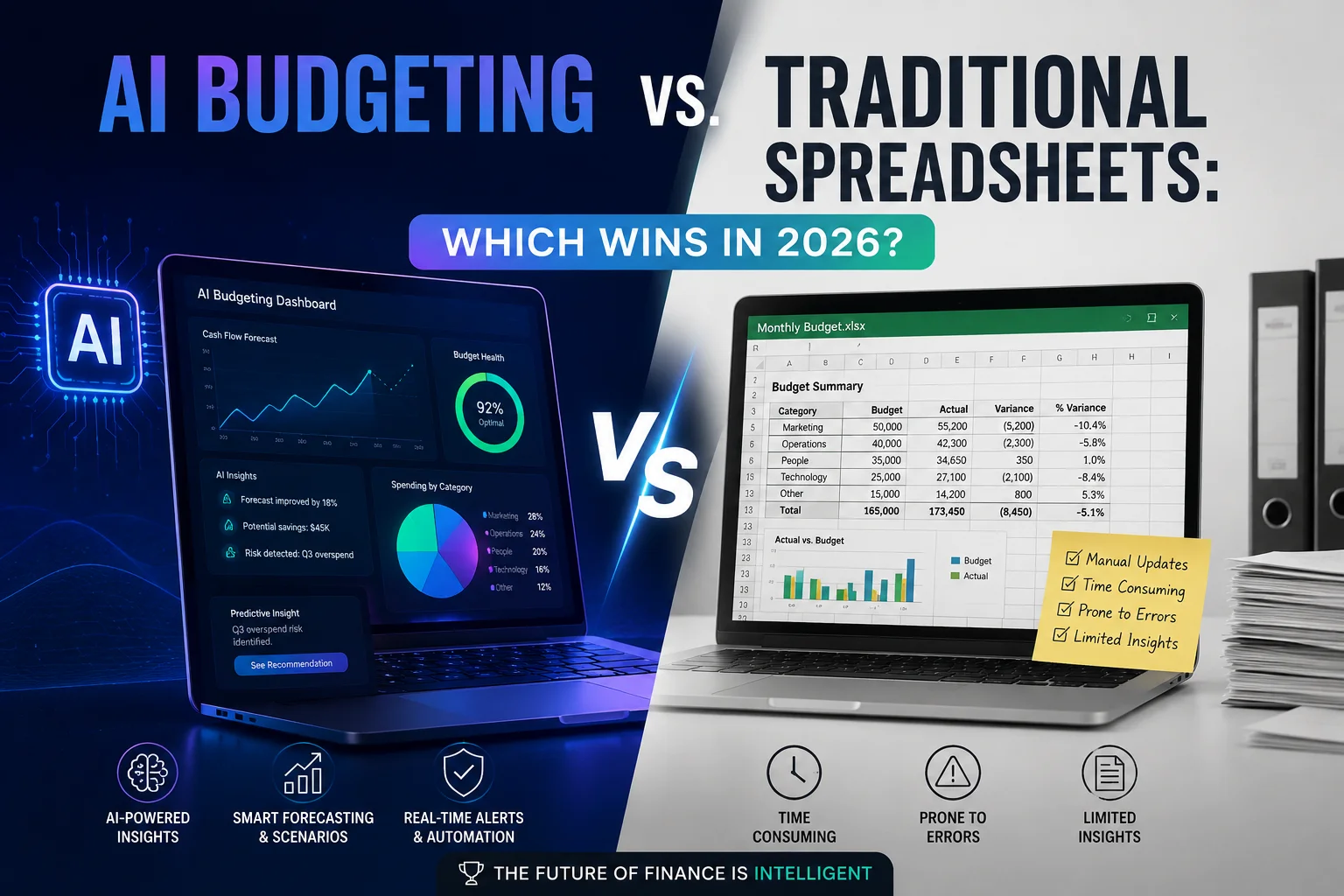
AI vs Spreadsheet budgeting: For decades, the “Gold Standard” of personal finance in the United States was a meticulously maintained Excel file. We spent Sunday evenings hunched over laptops, typing in $4.50 for a Starbucks latte and $120 for the Duke Energy bill. It was a badge of honor—a sign of “financial discipline.”
But as we move through 2026, the landscape has shifted. The “Laziness Factor” is no longer a character flaw; it is a competitive advantage. In a fast-paced US economy where the average household expenditure has risen significantly, nobody has the time to manually categorize 40+ transactions a week.
The debate is no longer just about where you store your data; it’s about whether your budget works for you or if you work for your budget. In this head-to-head comparison, we’ll look at why AI-driven tools are challenging the throne of the traditional spreadsheet.
1. The “Laziness Factor”: Why Manual Entry is Dying

In 2026, “friction” is the enemy of consistency. The Bureau of Labor Statistics reports that the average American worker has limited time for “household management.” If your budgeting system requires 60 minutes of data entry every week, you are statistically likely to quit within three months. This is where Daily Productivity Habits come into play—automating the mundane to focus on the meaningful.
AI budgeting wins the laziness test because it removes the “human” from the data pipeline. Instead of you logging into your Chase or Bank of America app, downloading a CSV, and uploading it to a sheet, AI tools use secure APIs to pull data in real-time. According to Pew Research , Americans are increasingly comfortable with AI handling routine tasks.
Why this matters for Americans:
- Automatic Categorization: When you shop at Target, AI knows if you bought groceries or a new TV based on your history.
- Subscription Detection: Americans now spend hundreds on subscriptions. AI identifies these “hidden” leaks automatically.
- Zero-Effort Updates: Your net worth updates while you sleep.
2. Traditional Spreadsheets: The Old Guard of Finance

Excel and Google Sheets are the “manual transmissions” of the financial world. They offer total control and privacy. For the “super-savers” in the US who want to customize every single formula, a spreadsheet is still a powerful tool. Many enthusiasts use spreadsheets to track Personal Finance Habits with granular detail.
Pros of Spreadsheets in 2026:
- Customization: You can build a 5-year plan for a mortgage down payment on a house in Austin, TX, with specific tax-advantaged account assumptions.
- No Monthly Fees: Unlike AI apps that cost $10–$15/month, a spreadsheet is essentially free.
- Privacy: Your data isn’t sitting on a third-party server; it’s on your local drive or private cloud, a concern highlighted in Consumer Financial Protection Bureau reports .
3. AI Budgeting: The Predictive Powerhouse of 2026
Modern AI tools have evolved past simple tracking. In 2026, they act as Predictive Financial Advisors. This helps reduce the cognitive load, serving as one of the best Stress Management Tips for those overwhelmed by debt.
Example Scenario:
Imagine you have a variable income as a freelance graphic designer in New York. A traditional spreadsheet only shows what you already spent. An AI tool analyzes your cash flow and says: “Based on your average income and upcoming utility bills, you will likely be $300 short by the 25th.” This level of foresight is explored in McKinsey’s research on AI in finance .
4. Head-to-Head Comparison: Features & Efficiency
| Feature | Traditional Spreadsheets (Excel) | AI Budgeting Tools (Monarch/Cleo) |
| Data Entry | Manual (High Friction) | Automatic (Zero Friction) |
| Categorization | Manual Rules | Machine Learning (95% accuracy) |
| Insights | Backward-looking (History) | Forward-looking (Predictive) |
| Time Required | 2–4 hours / month | 5–10 minutes / month |
| Security | High (Local Control) | High (Bank-level encryption) |
5. The US Financial Context: Taxes and Inflation
Managing money in the US is uniquely complex.
- IRS Deductions: If you are part of the gig economy, AI can automatically flag “Business Expenses” for your Schedule C .
- Inflation Adjustments: As US grocery prices fluctuate, AI provides real-time “Purchasing Power” updates. Understanding how to Improve Mental Wellness involves removing the anxiety caused by these shifting prices.
6. Calculations: The ROI of Your Time
Let’s calculate the “True Cost” of a manual spreadsheet vs. an AI subscription.
| Expense Category | Spreadsheet (Manual) | AI Budgeting Tool |
| Monthly Time Spent | 3 Hours | 0.2 Hours |
| Hourly Labor Value (US Avg) | $35.00 | $35.00 |
| Software Cost | $0.00 | $10.00 |
| Total Monthly “Cost” | $105.00 | $17.00 |
Annual Savings with AI: $1,056 in time-value.
7. The Verdict: Which Should You Choose?
In 2026, AI wins for 90% of US consumers. The ability to see your “True Cash Flow” without lifting a finger is the ultimate hack for Smart Money Management . While Excel remains the king of customization, AI is the king of action.
8. 25 FAQs About AI vs. Spreadsheet Budgeting
- Is AI budgeting safer than using Excel? Both are safe, but AI tools use “Read-Only” tokens. Learn more about Financial Goal Setting securely.
- Which AI budgeting app is best for US families? Monarch Money is a top choice for collaborative tracking.
- Can AI tools help with IRS tax prep? Yes, by auto-tagging tax-deductible expenses throughout the year as suggested by IRS.gov .
- Do these apps work with small US credit unions? Most use Plaid to connect to 11,000+ banks.
- What is the “Laziness Factor”? It’s about building systems that require zero willpower.
- Can I export my AI data to a spreadsheet? Yes, most offer CSV exports for those seeking Overcoming Procrastination in Finance .
- Does Rocket Money cancel subscriptions? Yes, they provide a concierge service for US providers.
- How much does AI budgeting cost? Usually $8–$15/month according to Forbes Advisor .
- Is Google Sheets better than Excel? Sheets is better for collaboration; Excel for data power.
- Can AI predict my credit score? Many include simulators based on FICO data.
- Do I have to link my bank account? For automation, yes.
- What if the AI categorizes something wrong? You can manually override and “teach” it.
- Is manual budgeting better for overspenders? It provides more “friction,” which can help some people stop spending.
- Can AI track my 401(k)? Yes, most integrate with providers like Vanguard or Fidelity.
- Does AI help with Zero-Based Budgeting? Yes, apps like YNAB are integrating AI for this.
- Are there free AI tools? Cleo offers a free basic tier.
- Can AI help me save for a house? Yes, it calculates your “Safe-to-Save” amount.
- How does AI handle cash? You must log cash transactions manually.
- Can AI tools detect fraud? Yes, by flagging unusual transaction patterns .
- Is Mint still available? Mint was moved to Credit Karma by Intuit .
- How do I start automatic tracking? Download an app and link your primary US bank account.
- Will AI make me lazy? No, it helps you achieve Achieving Work-Life Balance.
- Can AI help with student loans? Yes, through integration with Federal Student Aid .
- Is my data sold? Paid apps usually don’t; free ones might. Always check the privacy policy.
- Can I track a side hustle? Yes, AI is perfect for separating 1099 income as noted by the SBA .
Disclaimer:
This content is for informational and educational purposes only and does not constitute financial, legal, tax, or professional advice. Readers in the United States should consult licensed professionals, such as a Certified Financial Planner (CFP) or CPA, before making important financial decisions.
Official Reference Links
- U.S. Bureau of Labor Statistics – Consumer Expenditures
- IRS – About Schedule C (Form 1040)
- Pew Research Center – AI in Daily Life
- Federal Reserve – Economic Well-Being of U.S. Households
- Investopedia – AI in Finance
- Forbes Advisor – Best Budgeting Apps of 2026
- Consumer Financial Protection Bureau (CFPB) – Financial Data Rights
- McKinsey & Company – Tech & AI Insights
- U.S. Department of the Treasury
- Stanford HAI – Artificial Intelligence Index Report 2026
Meet the Author
Azhar Huzaifa Razaq
Azhar Huzaifa Razaq is a certified life coach, lifestyle publisher, and data-driven digital monetization strategist based in Peshawar, Pakistan. Specializing in behavioral psychology, structural habit development, and search engine optimization (SEO), he bridges the gap between deep cognitive science and practical execution. Through his work at digital lifestyle platforms, Azhar crafts framework-driven content that balances human-first value with rigorous programmatic advertising standards.