
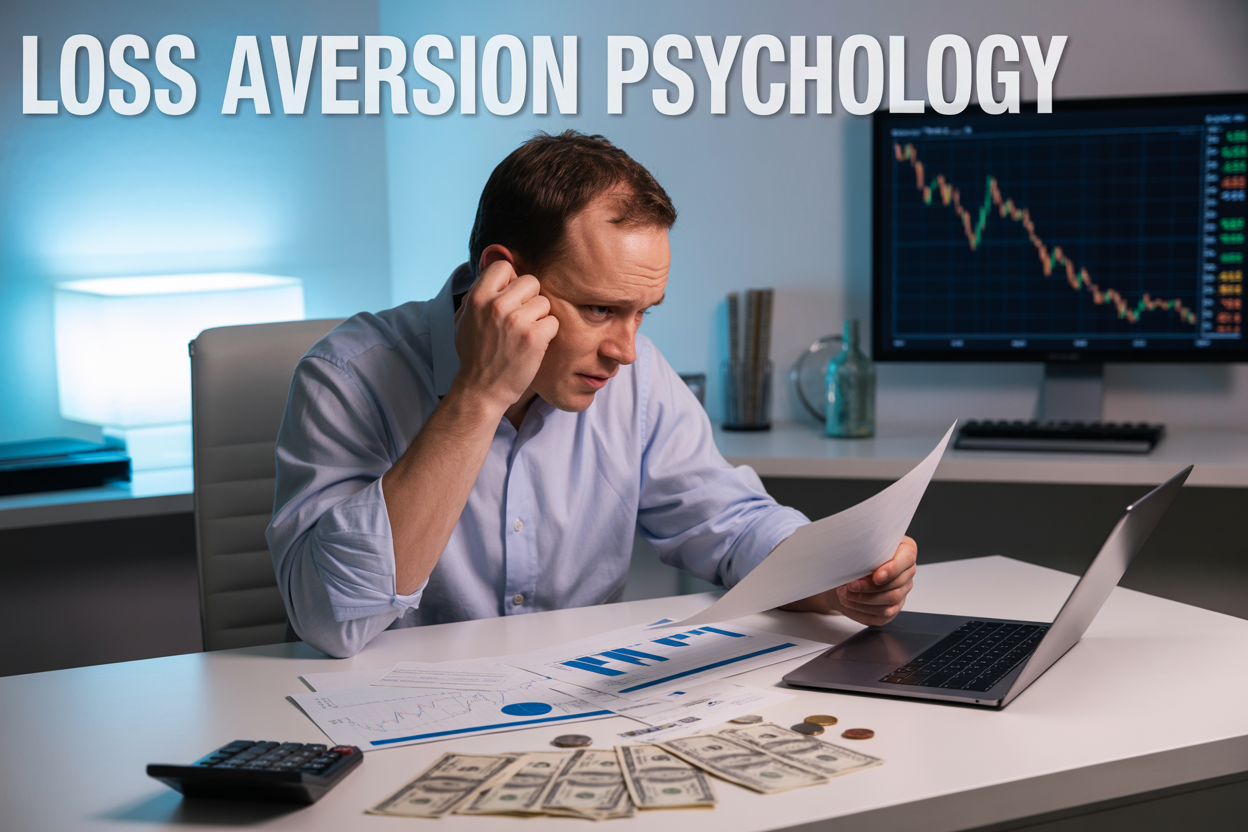
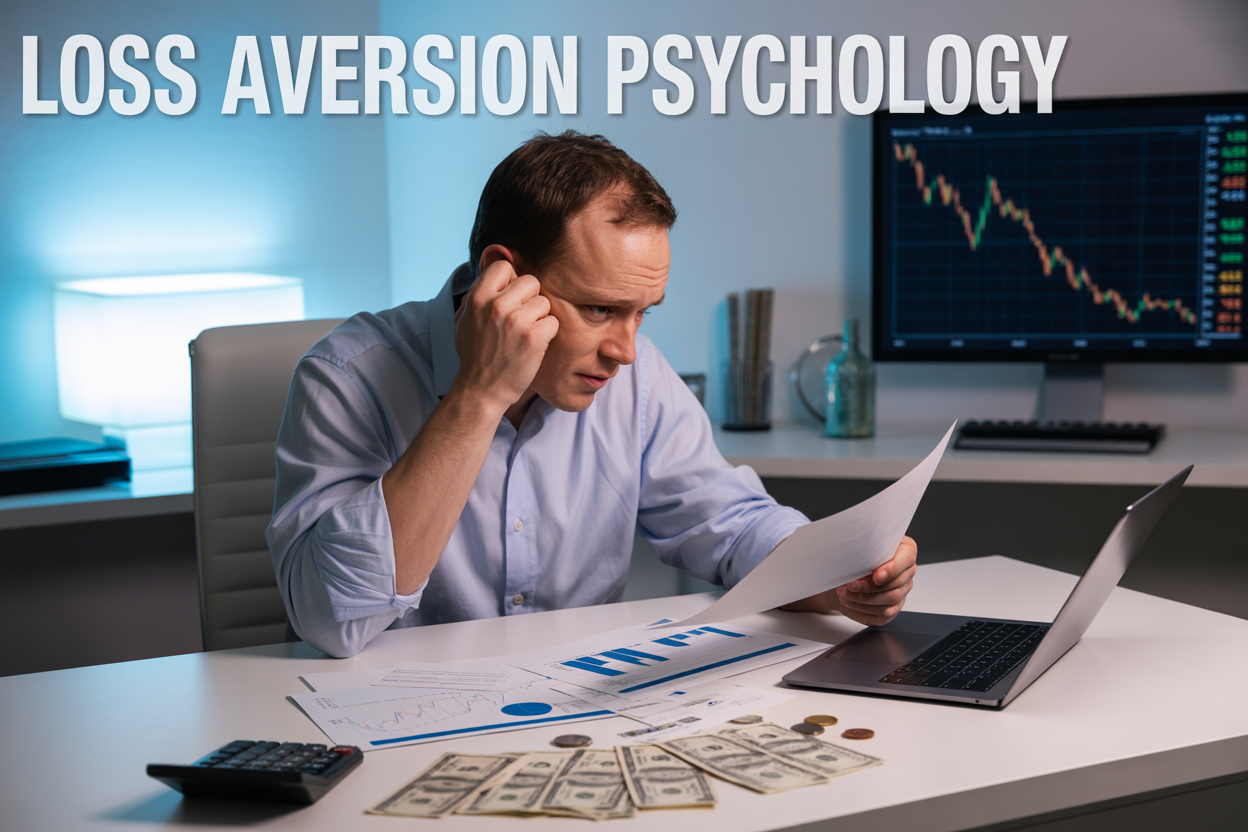
Most people would rather avoid losing $100 than gain $100. This quirk in how our brains work—called loss aversion psychology—explains why smart people make terrible money choices every day.
this guide is made by me for the people who make bad money Decisions if you follow this full guide you will ne able to make good Decisions and save your Money for future
If you’ve ever held onto a losing stock too long, bought something because it was “on sale,” or avoided investing because you might lose money, this article is for you. Whether you’re an investor, business owner, or just someone who wants to make better financial decisions, understanding this powerful bias can save you thousands of dollars.
We’ll explore how loss aversion tricks your brain into making poor money choices and why the fear of losing feels twice as powerful as the joy of winning. You’ll discover the most common money mistakes people make when loss aversion takes over, from panic selling during market dips to falling for marketing tricks that prey on your fear of missing out.
Most importantly, we’ll share practical ways to recognize when loss aversion is influencing your decisions and give you tools to make smarter financial choices despite this hardwired bias.
Understanding Loss Aversion and Its Psychological Roots

How your brain processes losses differently than gains
Your brain treats losses and gains like two completely different creatures. When you gain $50, your brain’s reward centers light up with moderate pleasure. But when you lose that same $50, your brain sounds alarm bells that register the pain as roughly twice as intense. This isn’t a character flaw – it’s hardwired neural architecture.
The amygdala, your brain’s fear center, processes potential losses as threats to survival. Meanwhile, gains activate the prefrontal cortex and reward pathways, but with much less intensity. Neuroimaging studies show that loss aversion psychology creates asymmetrical brain activity, with losses triggering stronger electrical responses than equivalent gains.
This processing difference explains why people often make irrational money decision making psychology choices. Your brain essentially weighs losses more heavily on its internal scale, making you risk-averse even when taking calculated risks could benefit you financially.
The evolutionary advantage that now hurts your wallet
Loss aversion served our ancestors brilliantly. In prehistoric times, losing food meant starvation. Losing shelter meant death. Those who carefully guarded resources survived, while risk-takers often perished. Natural selection favored the cautious.
Today’s financial landscape flips this survival strategy on its head. Behavioral finance bias toward avoiding losses can prevent you from:
- Investing in growth opportunities
- Switching to better financial products
- Taking calculated business risks
- Diversifying portfolios appropriately
Your ancient brain still operates as if losing money threatens your physical survival, even when modest losses pose no real danger to your well-being.
Why losing $100 feels worse than gaining $100 feels good
The mathematical reality is stark: losing $100 produces emotional pain equivalent to the joy of gaining $200-250. This 2:1 or 2.5:1 ratio appears consistent across cultures and income levels.
Fear of loss psychology creates this imbalance through several mechanisms:
| Loss Experience | Gain Experience |
|---|---|
| Immediate, intense pain | Gradual, moderate pleasure |
| Triggers stress hormones | Releases mild dopamine |
| Focuses attention sharply | Allows distraction easily |
| Creates lasting memories | Fades quickly from memory |
This emotional asymmetry drives poor financial choices. You might avoid switching banks to save $200 annually because you fear losing your current relationship. Or you’ll hold losing investments too long, hoping to avoid realizing the loss. Loss aversion in finance makes people prioritize avoiding small losses over pursuing larger gains, ultimately limiting their wealth-building potential.
The intensity difference also explains why promotional offers emphasizing what you’ll “lose” by not acting often outperform those highlighting potential gains. Your brain simply can’t ignore the threat signal that losses represent.
Common Money Mistakes Driven by Loss Aversion

Holding onto losing investments too long
When stock prices drop, most investors feel an overwhelming urge to hold on rather than sell at a loss. This behavior stems from loss aversion psychology – the mental pain of realizing a loss feels twice as intense as the pleasure from an equivalent gain. Your brain tricks you into believing that as long as you don’t sell, you haven’t actually lost money.
This thinking creates a dangerous trap. Investors often pour more money into declining stocks, hoping to “average down” their cost basis. They convince themselves the market will eventually recover their losses, ignoring fundamental changes that might have caused the decline in the first place.
Professional traders call this “throwing good money after bad,” but behavioral finance bias makes it feel logical to everyday investors. You might hold onto a stock that’s dropped 30% while quickly selling winners that have gained 15%, completely backwards from sound investment strategy.
The financial cost extends beyond the immediate loss. Money tied up in losing positions can’t be invested in better opportunities. This opportunity cost compounds over time, turning small mistakes into major setbacks for long-term wealth building.
Avoiding beneficial financial risks
Fear of loss psychology often prevents people from taking calculated risks that could significantly improve their financial situation. You might keep all your money in low-yield savings accounts, avoiding stock market investments despite their historical outperformance over long periods.
This risk aversion shows up in career decisions too. Many people stay in underpaid jobs rather than negotiate salaries or pursue better opportunities, fearing the potential loss of their current income security. The psychological comfort of the status quo outweighs the logical benefits of making a change.
Money decision making psychology explains why people avoid refinancing mortgages even when rates drop significantly. The upfront costs and paperwork feel like immediate losses, while the long-term savings feel abstract and uncertain. Your brain focuses on what you might lose today rather than what you could gain tomorrow.
Small business ownership often falls victim to this bias. People with viable business ideas stay in corporate jobs because entrepreneurship involves potential financial loss, even when the upside potential far exceeds the downside risk.
Making impulsive purchases to avoid missing out
Retailers exploit loss aversion in finance through “limited time offers” and “flash sales” that create artificial scarcity. Your brain interprets missing a deal as a loss, triggering impulsive buying decisions that often contradict your budget and financial goals.
Credit card companies amplify this effect with rewards programs and cash-back offers. You feel like you’re losing money by not using their cards, even when the interest charges and fees exceed any rewards earned. The immediate fear of missing rewards overshadows the long-term cost of debt.
Subscription services master this psychological manipulation. Free trials convert to paid subscriptions because canceling feels like giving up something you already possess. Auto-renewal features bank on your tendency to avoid the “loss” of canceling, even when you rarely use the service.
Investment platforms now use similar tactics with “hot stock alerts” and time-sensitive trading recommendations. The fear of missing the next big winner drives hasty investment decisions without proper research or consideration of your overall portfolio strategy.
Staying in unfavorable financial situations
Loss aversion in finance keeps people trapped in expensive banking relationships, high-fee investment accounts, and unfavorable insurance policies. Switching feels risky because you might lose familiar customer service or face temporary inconveniences, even when better options clearly exist.
Many homeowners stay in properties they can’t afford rather than downsize or relocate. The emotional attachment to their current home, combined with fear of “losing” their investment, prevents rational financial decisions that could improve their overall situation.
Debt consolidation often gets delayed for similar reasons. People continue paying multiple high-interest credit cards rather than pursue personal loans or balance transfers with better terms. The complexity of change feels more threatening than the ongoing financial drain.
Professional relationships suffer from this bias too. Clients stick with underperforming financial advisors, accountants, or insurance agents because switching involves admitting the current relationship isn’t working. The fear of making a wrong choice paralyzes decision-making, keeping people in suboptimal financial arrangements for years.
How Loss Aversion Manipulates Your Investment Decisions

The Sunk Cost Fallacy in Stock Market Investing
Investors routinely fall victim to the sunk cost fallacy, throwing good money after bad simply because they’ve already invested time and capital into a losing position. This behavioral finance bias stems directly from loss aversion psychology – the pain of admitting defeat feels worse than the potential benefits of cutting losses and moving forward.
Picture this scenario: You bought XYZ stock at $50 per share, and it’s now trading at $30. Instead of selling and accepting the $20 loss, you convince yourself to hold on or even buy more shares because “you can’t afford to lose money.” The irational thinking goes: “I’ve already put $5,000 into this stock, so I need to stick with it until it recovers.”
This money decision making psychology ignores a fundamental investment principle – past investments shouldn’t influence future decisions. The $20 per share you’ve already lost is gone regardless of what you do next. The only question that matters is: “Given what I know today, is this stock likely to perform better than alternative investments?”
Professional traders understand this concept well. They set stop-loss orders and stick to predetermined exit strategies because they recognize that emotional attachment to losing positions destroys portfolios. Fear of loss psychology keeps amateur investors trapped in declining stocks while missing opportunities in better-performing assets.
Why Diversification Feels Emotionally Difficult
Diversification goes against every instinct shaped by loss aversion in finance. When you spread your investments across multiple asset classes, some will inevitably underperform while others excel. This creates a constant psychological tension where you’re simultaneously experiencing gains and losses.
Your brain doesn’t process these mixed results rationally. Instead, it fixates on the losing positions and questions whether diversification was the right choice. You might find yourself thinking: “If I had just put everything into that tech stock that’s up 30%, I’d be so much better off than holding these bonds that barely moved.”
This emotional struggle explains why many investors abandon diversified portfolios during bull markets. They watch concentrated positions in popular stocks or sectors generate impressive returns and feel like they’re missing out. The fear of loss psychology kicks in – not just fear of losing money, but fear of losing potential gains.
| Emotional Response | Diversified Portfolio Reality |
|---|---|
| “I’m missing out on big gains” | Reducing overall risk while capturing market returns |
| “Some investments are dragging me down” | Normal portfolio behavior across market cycles |
| “I should pick winners instead” | Market timing rarely works consistently |
Smart investors train themselves to view their entire portfolio as a single unit rather than focusing on individual components. They understand that the “losers” in their portfolio often provide the protection needed when market conditions change.
How Fear of Losses Prevents Wealth Building
The most devastating impact of loss aversion on investment decisions is how it prevents people from building long-term wealth. This behavioral finance bias creates a psychological barrier that keeps investors focused on avoiding short-term losses rather than maximizing long-term gains.
Conservative investors often park their money in low-yield savings accounts or bonds, believing they’re being “safe.” While these investments protect against immediate losses, they fail to keep pace with inflation over time. The fear of loss psychology convinces them that a guaranteed 2% return is better than risking market volatility for potentially higher returns.
Meanwhile, aggressive investors make the opposite mistake. They take excessive risks chasing quick profits, often buying high during market euphoria and selling low during panics. Both approaches stem from the same psychological bias – an inability to properly weigh potential losses against potential gains.
Successful wealth building requires accepting that short-term volatility is the price of long-term growth. Historical data shows that diversified stock market investments have consistently outperformed “safe” alternatives over periods of 15-20 years or more. Yet loss aversion psychology makes it emotionally difficult to stay invested during inevitable market downturns.
The key lies in understanding that temporary portfolio declines are not true losses unless you sell. Paper losses recover over time in well-diversified portfolios, but the opportunity cost of staying in low-growth investments is permanent. Every year you avoid the stock market due to fear of losses is a year of potential compound growth you’ll never recover.
Marketing Tactics That Exploit Your Loss Aversion Bias

Limited Time Offers and Artificial Scarcity
Companies masterfully weaponize loss aversion psychology by creating urgent situations where you feel like you’re about to miss out. Those countdown timers on shopping websites? They’re tapping directly into your fear of loss psychology. When you see “Only 3 left in stock!” or “Sale ends in 2 hours,” your brain shifts into panic mode, worried about losing a deal rather than rationally evaluating whether you actually need the product.
Retailers often manufacture scarcity where none exists. Airlines show “Only 2 seats left at this price” even when they have dozens of seats available at various price points. The psychological pressure makes you book immediately rather than shop around or consider whether the trip fits your budget.
This behavioral finance bias explains why people make impulsive purchases during flash sales, often buying items they never intended to get. The fear of missing out overrides logical money decision making psychology, leading to purchases that hurt long-term financial goals.
Free Trial Periods That Hook You Into Subscriptions
Free trials exploit loss aversion in finance by making cancellation feel like losing something you already own. Once you start using a service, even for free, your brain begins to view it as yours. Companies bank on this psychological ownership effect.
The process works like this: you sign up for a “free” streaming service or software trial, start using it regularly, and then face the painful decision of “giving up” your access when the trial ends. Even if you barely use the service, the thought of losing it triggers your loss aversion instincts.
Monthly subscription charges often fly under the radar because they’re small amounts, but they add up significantly over time. Many people keep subscriptions they rarely use simply because canceling feels like losing something valuable. The companies know this and make cancellation processes deliberately complex to amplify the psychological cost of letting go.
Insurance Upsells That Prey on Worst-Case Scenarios
Insurance salespeople are trained to paint vivid pictures of catastrophic scenarios to trigger your fear of loss psychology. They don’t sell coverage; they sell peace of mind by making you imagine devastating financial losses.
Extended warranties on electronics, gap insurance on car loans, and travel insurance with excessive coverage all exploit the same principle. Sales representatives focus on worst-case scenarios rather than statistical probabilities, making you feel vulnerable without their additional protection.
The strategy works because humans naturally overestimate the likelihood of rare, dramatic events. You’ll pay extra for rental car insurance even though your regular policy likely covers you, simply because the rental agent emphasizes potential massive repair bills.
| Common Insurance Upsell | Actual Need Level | Why We Buy It |
|---|---|---|
| Extended warranties | Low for most products | Fear of expensive repairs |
| Travel insurance | Moderate | Worry about trip cancellation |
| Gap coverage | Depends on loan terms | Fear of owing more than car’s worth |
Loyalty Programs That Make Switching Feel Costly
Loyalty programs create artificial switching costs that have nothing to do with actual financial loss. Credit card points, airline miles, and coffee shop punch cards make you feel like switching providers means abandoning valuable rewards you’ve already “earned.”
These programs exploit loss aversion in finance by making the accumulated points feel like real money in your pocket. You’ll stick with a credit card that doesn’t serve your needs well just because you have 50,000 points, even though those points might only be worth $500 while the annual fee costs you more in the long run.
Retailers design these programs to create emotional investment in their brand. The more points you accumulate, the harder it becomes to walk away, even when competitors offer better prices or services. Your behavioral finance bias convinces you that switching means losing your reward balance, when in reality, you might save more money elsewhere.
The psychology becomes even more powerful when programs have tiered status levels. Reaching “Gold” or “Platinum” status feels like an achievement, making you more likely to concentrate your spending with one provider to maintain that status, regardless of whether it’s the most cost-effective choice for your money decision making psychology.
Practical Strategies to Overcome Loss Aversion in Financial Planning

Reframing Losses as Learning Investments
The biggest shift in conquering loss aversion psychology starts with changing how you view financial setbacks. Instead of seeing a dropped investment value as money vanishing into thin air, treat it as tuition for your financial education. Professional traders call this “paying for market lessons” – each mistake teaches you something valuable about risk management, market timing, or investment selection.
When you lose money on a stock pick, ask yourself what specific lesson this experience taught you. Maybe you learned not to chase hot tips from social media, or perhaps you discovered the importance of diversification. Write these lessons down and refer to them before making future decisions. This reframing transforms the emotional pain of loss into intellectual growth, making it easier to move forward rationally.
Create a “learning portfolio” where you track both wins and losses alongside the lessons learned. Over time, you’ll notice patterns in your money decision making psychology and develop better financial instincts.
Setting Predetermined Rules for Financial Decisions
Your brain works differently under stress, which is why establishing clear rules during calm moments protects you from emotional decision-making later. Think of these rules as your financial GPS – they keep you on track even when the road gets bumpy.
Start by creating specific triggers for buying and selling investments. For example: “I’ll sell if any individual stock drops 20% from my purchase price” or “I’ll rebalance my portfolio every six months regardless of market conditions.” Write these rules down and share them with a trusted friend or advisor who can hold you accountable.
The key is making these rules specific and measurable. Vague guidelines like “sell if things get bad” won’t help when behavioral finance bias kicks in. Instead, use concrete numbers and timeframes. This approach removes the guesswork and prevents you from second-guessing yourself when markets get volatile.
Using Automation to Remove Emotional Decision-Making
Technology becomes your best friend in fighting loss aversion in finance. Automated investing takes human emotion completely out of the equation, forcing you to stick with your long-term strategy even when your gut screams to do otherwise.
Set up automatic transfers from your checking account to investment accounts on specific dates each month. This dollar-cost averaging approach means you buy more shares when prices are low and fewer when prices are high, smoothing out market volatility over time. You won’t even think about timing the market because the system handles everything.
Consider robo-advisors for hands-off portfolio management. These platforms automatically rebalance your investments and handle tax-loss harvesting without requiring your input. When you remove the ability to make impulsive changes, you eliminate the opportunity for fear of loss psychology to derail your financial progress.
Focusing on Long-Term Gains Rather Than Short-Term Losses
Your investment timeline dramatically affects how losses feel. A 10% drop hurts much more when you check your portfolio daily compared to reviewing it annually. Train yourself to zoom out and see the bigger picture of your financial journey.
Create visual reminders of your long-term goals. If you’re investing for retirement in 30 years, calculate how temporary market downturns barely register as blips on a three-decade timeline. Historical market data shows that despite numerous crashes and corrections, patient investors who stayed the course consistently built wealth over extended periods.
Block access to daily market updates and portfolio apps during volatile periods. Check your investments quarterly instead of daily. This simple change reduces the frequency of experiencing small losses, which psychologically feel much larger than they actually are in the context of long-term wealth building.

Loss aversion shapes our money decisions more than we realize, often leading us to hold onto losing investments too long, avoid beneficial risks, and fall for marketing tricks designed to trigger our fear of missing out. The psychological pull to avoid losses can be twice as strong as the satisfaction we get from gains, making it one of the most powerful forces working against our financial success. From keeping underperforming stocks to choosing expensive insurance we don’t need, this bias costs us real money every day.
The good news is that awareness gives you power over these automatic reactions. Start by questioning your gut feelings about money decisions, especially when they involve avoiding change or sticking with the status quo. Set clear investment rules ahead of time, automate your savings to remove emotion from the equation, and remember that small, calculated risks today often prevent bigger losses tomorrow. Your brain might be wired to fear loss, but you can train yourself to make smarter choices that actually protect and grow your wealth.
Disclaimer:
This article is for information and learning only. This article neither includes nor recommends any information about how to address medical, psychological, or financial issues. If you face severe stress, anxiety, and depression, please seek a qualified professional.
Written by Azhar Huzaifa
Azhar Huzaifa is the founder of LifeBalanceInsight.com.
He writes about money psychology, health, and life balance,
helping middle-class families reduce stress and live better lives.